
(Nikhil Erinjingat is a third year student at Ramaiah College of Law, Bengaluru)
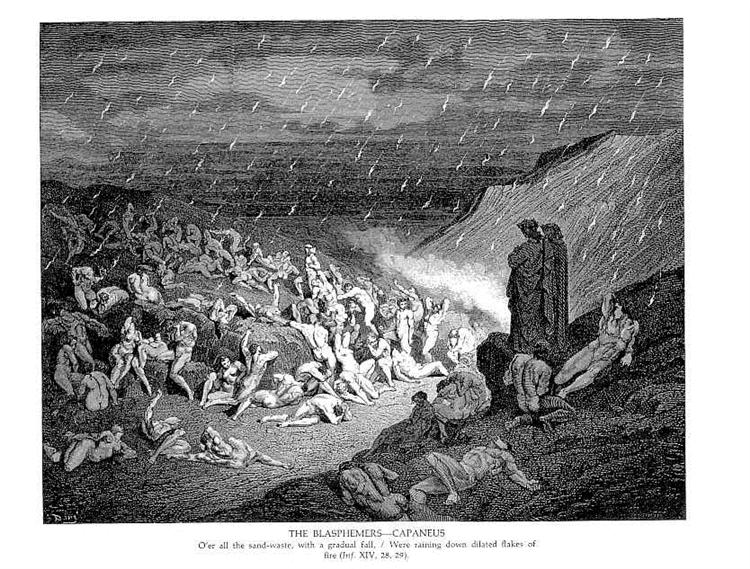
Painting Illustration – “The Blasphermers – Capaneus” by Gustave Dore
On 11 August 2020 Bangalore city saw one of the worst riots in recent history. A Facebook post insulting Prophet Mohd instigated more than 200 people to vandalize and destroy public and private properties. The Police were forced to fire gunshots to control the mob which cost the lives of three persons. Bangalore Police arrested the person responsible for the post and over a hundred people were part of the riot. The person who posted the ‘derogatory’ post will be charged under Section 295A of the Indian Penal Code 1860 (IPC). Similarly, a man who called RSS men pigs on a social media platform was booked under Section 295A of IPC. The Government of India has also banned the book- ‘Satanic Verses’ by Salman Rushdie for being blasphemous.
All the three instances involved publication (or potential publication) of content which hurt the religious sentiments of a class of citizens, and the Government used provisions under the criminal law, namely, Section 153A, 295 and 295A of the IPC, and Section 95 of the Criminal Procedure Code 1973 (CrPC), as a means to maintain public order. However, in several instances, censorship or ban may cause restriction on freedom of speech and expression. The Courts have addressed the constitutionality of these ‘blasphemy laws’ and held it to be within the reasonable restrictions under Article 19(2) in Ram Ji Lal Modi v State of UP[i].
There is a plethora of legal material arguing for and against the constitutionality of the ‘blasphemy’ laws. However, very little attention is paid to truth as a defense for religious blasphemy. Truth as a defense is considered mostly in arguments for civil and criminal defamation cases, and not religious-blasphemy. The cause for it may be the difficulty in proving what is true or false in matters of religion. Be that as it may, ‘truth’ is a fundamental facet of justice and no one emphasized on the quest for the truth more than Mahatma Gandhi. The article thus argues that despite the difficulty in proving what the truth is, truth must be recognized as a defense in cases of ‘blasphemy’ to uphold the right of free speech.
SECTION 153A OF THE INDIAN PENAL CODE
Section 153A punishes persons who promote enmity between different groups on the grounds of religion, race, place of birth, residence, language etc., and acts which are prejudicial to maintenance of harmony. Section 153A was used by the Police in the aforementioned examples as well. Many have critiqued the provision to be contrary to the right to freedom of speech and expression. However, the courts have upheld the validity of the provision in several judgements; one being Baku Patel v. The State[ii]. Further, the Karnataka High Court recently held that Section 153A will be attracted when the words promote or incite enmity between members of the same religious group or sect.
SECTION 295 AND 295A OF THE INDIAN PENAL CODE
Both the sections 295 and 295A were framed by the British but the latter was inserted thereafter to overcome the shortcomings of the former. The Supreme scrutinized the constitutionality of Section 295A in Ram Ji Lal Modi v The State of UP[iii] and held the provision to be constitutional. The Court held that such provisions are to uphold law and order, thus within the reasonable restrictions under Article 19(2) pf the Constitution. The Court in Superintendent, Central Prison Fatehgarh v Ram Manohar Lohia[iv] defined the scope for application of the provision to those instances where the insults were malicious and deliberate and stated that there must be a proximate link between speech and public disorder. However, the court in Sri Baragur Ramachandrappa v State of Karnataka[v] held that if the comment on religion is “unwarranted” it will amount to an offence under Section 295A, without specifying what constituted “unwarranted”. Such a decision of the Court puts a further limitation on the exercise of free speech, since an individual is not only obligated to decide ‘what to say’ but also ‘when to say’ and ‘where to say’. The author concedes to the fact that free speech is not an absolute right and has restrictions such as public order and morality. These restrictions are extremely subjective and thus in a liberal democracy where the free speech of an ‘individual’ is protected the law and its interpretation must lean towards the individual’s right instead of the society’s subjective morality. Further, the words need not actually hurt the religious sentiments of people, but a mere possibility of that is sufficient. Thus, the court, therefore, diluted the test of determining what constitutes an offence under Section 295A.
SECTION 95 OF THE CRIMINAL PROCEDURE CODE, 1973
Under Section 95 of CrPC, the Government is empowered to ban publications which if published will be an offence under Section 124 or 153A or 153B or 292 or 293 or 295A of IPC. In Ramlal Puri v. State of M.P,[vi] it was held that the right under Article 25 does not prevent the State from making laws for the maintenance of law and order, and thus the government may ban publications which will disturb public order. Section 95 is a preventive measure and not punitive. It censors content on the basis of a possibility of disruption of public order and morality.
TRUTH AS A DEFENSE
Truth as a defense for blasphemy was considered by in State of Mysore v. Henry Rodrigues[vii] and rejected as the judges believed that it cannot be enforced effectively. The courts neglected a valid argument on the basis of difficulty in enforcement. Similarly, in Gopal Godse v. Union of India[viii] Justice Y V Chandrachud held that truth when mischievous has a greater impact on the minds of people, and thus refused to recognise truth as a defence against Section 153A. Further, the Supreme Court has held that truth is not a defence for an offence under Section 153A. Thus, when a person makes a true statement, if she/he knows that it will cause public disharmony, she/he must not say it or the State will censor it.[ix]
The role of government is to ensure public order while ensuring that freedom of speech and expression is protected, and censoring speech that is true does not uphold freedom of speech. The health of a democracy can be measured in terms of how freely people are able to criticise ideas and policies not just of the government but also fellow citizens. Public morality is an evolving concept and the State not only has an obligation to ensure public order but also a healthy democracy. And for a healthy democracy, free speech is indispensable. Some exercise of free speech might be utterly false. However, censoring truthful statements because the sentiments/morality of certain sections of society is hurt, seems to be an imposition of the morality of others on the individual.
Article 51A (h) of the Constitution of India states that it shall be the duty of every citizen to develop scientific temper. And scientific inquiry often begins with a close examination of evidence and may lead to conclusions which might hurt the sentiments of the religious communities since science and religion are sometimes incompatible, if not at all times. Thus, when religions are being called barbaric or unreasonable, the scientific method dictates that religious texts be studied to determine the truth instead of burning public property. It also becomes pertinent to understand that despite the well-established principle that secularism in India is not atheistic and inclusive of all religious beliefs, the framers of the Constitution recognised the potential conflict between the right to religion and other fundamental rights, including freedom of speech and expression. Consequently, Article 25 of the Constitution of India, within its provision, states that right to religion is subject to ‘other provisions of this Part’. Thus, every other fundamental right takes precedence over the right to religion. Thus, be it the Sabarimala decision or Triple Talaq decision, the Supreme Court has disregarded the practices and upheld equality.
When someone “insults” a religious figure (as in the case of Bangalore riots) the first step must be to figure out if the claim made is true. And if it is not, the person must be penalised. And if the statement made on Facebook is true, then penalising the person will mean penalising a person for saying the truth. The same is applicable in other instances of riots caused due to “blasphemous” comments. Thus, when Chief Justice Y V Chandrachud said that truth, when said for mischievous purposes, will have a greater effect (negative) on the minds of the people,[x] he did not put an onus on the individual whose sentiments were hurt to think reasonably and engage in discourse to resolve the conflict. Shifting the focus of fundamental rights to the restrictions will have a negative effect on democracy since discourses on “controversial” and “sensitive” topics will decline. When Justice Chandrachud used ‘mischievous’, he was referring to the intent to cause public disorder or hurt sentiments. However, when a person maliciously makes a true claim about religion or ideology which causes riots, what is unreasonable is the violence since in a democracy people are expected to think for themselves and engage in discourses. Ironically, Copernicus and Socrates were also censored for maliciously hurting public morality, and their works are now recognized as the foundation of modern astronomy and democracy. Thus, when a person is censored because he insults a religious text, what is essentially being done is that the morality of that religion is being imposed on the individual; since the book is sacred only as per that religion.
The effect of the laws can be illustrated by the following example:
Several religions have instances of virgin births. Historically and scientifically, there is no possibility of having IVF technology in ancient times. However, if someone scientifically and based on historical evidence establishes that same and consequently hurts the religious sentiments of people. The article can be banned by the government and if riots are instigated then the person who published the article may be arrested.
The example of a virgin birth is only one of the many and the author refrains from giving more examples because he believes that those examples though cited for academic study and true will hurt the religious sentiments of persons.
It can be argued that the State exercises its power to maintain public order. However, the duty of the State is to maintain public order with minimum restriction to individual freedoms of persons. If a true statement has a potential of causing a disturbance in public order the police must deploy additional manpower to curb it instead of censoring the truth. In State of Maharashtra v. Sangharaj and Ors., the court laid down various conditions to determine if a book should be censored, including the language of the book, the circumstance in which it was written and published. However, the court does not consider whether what is stated in the book is true. The truthfulness of the statement is disregarded and sentiments of persons are provided with the primary focus. When the truth is censored to protect the sentiments of the public, it defeats the purpose of beginning the fundamental rights with ‘every person/citizen’. Blasphemy laws promote public morality over individual freedoms, which is contrary to the ideals of constitutional morality.
[i] AIR 1957 SC 620
[ii] 1973 RLR 637
[iii] AIR 1957 SC 620
[iv] AIR 1960 SC 633
[v] (2007) 5 SCC 11
[vi] AIR 1971 MP 152
[vii] [1962] 2 Crim. LJ 564
[viii] 1971 Cr LJ 324
[ix] State of Maharashtra v. Sangharaj and Ors, (2010) 7 SCC 398, at para 23.
[x] Gopal Godse v. Union of India, 1971 Cr LJ 324
Leave a Reply