
(Roopam Dadhich and Pranshu Gupta are Fourth year students at NALSAR University of Law, Hyderabad.)
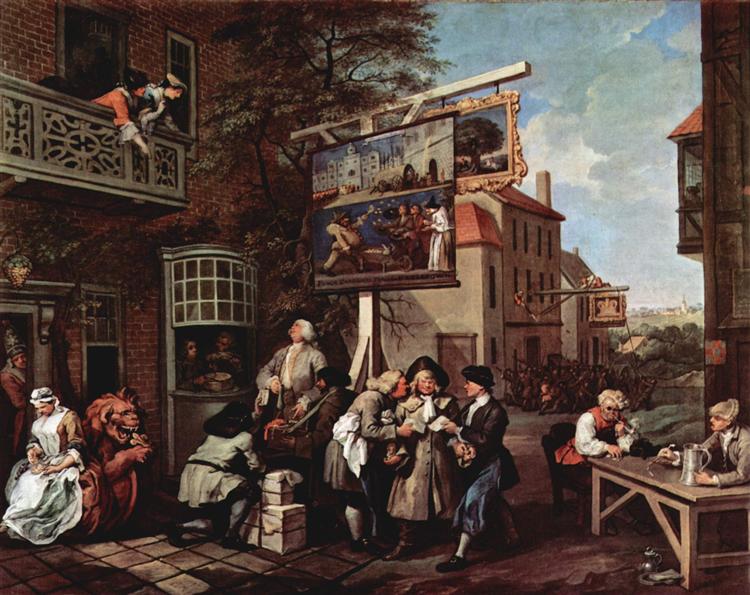
Featured Art: ‘Election Propaganda’ by William Hogarth
The Tenth Schedule of the Indian Constitution expounds on the provisions which bar the elected representatives from defecting from their political parties on the tickets of which they get elected. The anti-defection law says that a member of a House stands disqualified from her candidature if the member acts against the party lines. More specifically, the Tenth Schedule talks about two conditions, upon which the disqualification can be based. Firstly, Paragraph 2(1)(a) of the Tenth Schedule makes a member of a political party disqualified if he or she voluntarily abdicated the membership of the political party. Secondly, Paragraph 2(1)(b) states that a member is disqualified if he or she exercises voting rights or abstains from doing the same going against the directions given by the political party.
The core idea is to control the practice of horse-trading which promotes defection influenced by the temptation of money and office, along with the conservation of an ideology of the political party from which the candidate belongs and uses the same to get elected. However, the disqualification of the expelled party members was kept outside the scope of the Tenth Schedule upon which the research question of this article revolves. The status of a member who is expelled from the party membership by the political party on the ticket of which the candidate won the election is still ambiguous. Are the provisions of disqualification applicable to the expelled party members also?
Legislative intent
The legislative intent behind the passing of the anti-defection law was based on the notion that the nature of our democracy was largely dependent on the ideology of the political party. Therefore, the responsibility of a legislator is more as a representative of the political party than that as a representative of her constituency. These arguments were upheld in the case of Kihoto Hollohan v. Zachillhu in which the validity of the Tenth Schedule was questioned. The petitioner’s main argument was that the law violates the fundamental rights of free speech and expression in the Parliament itself and is hence violative of the basic structure as it stifles the voices of dissent. The Tenth Schedule strived to supersede the party politics over the legislator’s ideology for the demands of the constituency, and thus against the system of democracy. The Apex Court dismissed this reasoning by accepting firstly the unethical practice of defections in the political parties. Even though it accepted the importance of discourse and dissent in the Parliament, it also acknowledged the indispensable nature of the idea of shared beliefs within a political party and the actions of the members in the continuance of those shared beliefs. The court simply upheld the view that our democratic system works more on the party lines than the legislator’s conscience of her constituency.
If the intention of the lawmakers is investigated, it is clear from the Parliamentary debates during the tabling of the Tenth Schedule Bill in 1985 that the expelled members were supposed to be kept out of the ambit of the anti-defection law. In the 52nd Amendment Bill of the Constitution, a separate clause (c) was included along with clauses (a) and (b) in Paragraph 2(1) of the Bill. Clause (c) made applicable the anti-defection law on the members expelled from a political party. However, after severe opposition, it was excluded from the final Act.
The major opposition was with the fact that the expulsion of a member from a political party is an outdoor process that does not involve the procedure of the Parliament, and thus prone to more misuse as it would provide relentless power to the authoritarians of political parties. The lower house was clear on its position regarding the dropping of clause (c) as the dissent among the party lines outside the legislative assembly was considered a core feature of the democratic process. There was no contention against this unified idea of not having interference in the matters of party politics. Hence, it could be said without any doubt that the lawmakers never intended to apply the anti-defection law on the expelled party members. However, in 1996, the Supreme Court extended the application of the Tenth Schedule to the expelled members of the political parties in the case of G. Vishwanathan v. The Speaker.
Vishwanathan and the Textual interpretation
The Supreme Court in Vishwanathan opened up the debate on clause (c) as it used the same to explain the concept of deeming fiction through the explanation provided under Paragraph 2(1)(b). According to the explanation, any elected member would be deemed to belong to the same political party from whose ticket he or she won the election of a particular constituency. The court said that for the application of the Tenth Schedule, a member would still be part of the political party from which he got elected regardless of whether such party has expelled the member from the party. The member would keep on having a place with that political party regardless of whether he is treated as ‘unattached’. The further inquiry is when does an individual willfully surrender the membership of the party, as given in Paragraph 2(1)(a)? The voluntary aspect of giving up the membership could both be express or implied. If an expelled member of a political party joins a party other than the one from which he or she got elected, it will unquestionably add up to his deliberately surrendering the enrollment of the political party which had set him up as a contender for the political race all things considered. In simple words, a member belongs to the same political party even after expulsion till the point of time he or she joins another party or is disqualified.
However, the textual reading adopted by the court that prompts a counter-intuitive outcome, is not the only method for perusing the Tenth Schedule. The court based its reasoning in Vishwanathan on the deeming interpretation of the explanation provided for Paragraph 2, while it is established legally in the case of Bihar Co-operative Development v. Bank of Bihar by the Apex Court that an explanation of a particular provision can just explain its degree and cannot extend it. Considering this situation, if we interpret the provision without putting it as a subset of the explanation given, we get a simple word, ‘voluntary’, which ordinarily cannot be related to expulsion as a member who is expelled or has been made to leave the party without considering her will. Paragraph 2(1)(a) which talks about the voluntary abdication of party membership, thus does not apply to such members. At the same time, an expelled member does not qualify to be a member of the political party which expelled her. Therefore, 2(1)(b) of the Schedule doesn’t make a difference either. Since the provisions mentioned in Schedule for the disqualification of members for defection are exhausted, the Tenth Schedule does not apply to the expelled members.
At the same time in different decisions, the Supreme Court has shown that the connection between a voter and a candidate is normatively at any rate as significant as that of the job of the political party inside the Indian constitutional plan. A genuine case of this is a bunch of cases brought to the Court in the past few years, dealing with the disclosure of personal information of the members standing for elections. In Union of India v Association for Democratic Reforms, the Apex Court emphasized greatly on the importance of the relationship between a voter and the candidate. The inference here is that the Indian Constitutional plan contains components of both party-driven as well as constituency driven representative systems.
Now since the Indian Parliament works on a democratic system that consists of components of both the legislature-constituency driven model as well as party-driven model, the Tenth Schedule should not be deciphered in a manner that altogether benefits the latter over the former. In other words, if there comes a situation in which two interpretations are possible, the courts should not completely rely on the party-centric model but should strive to strike a balance between the two.
The issue of the interpretation of the Tenth Schedule provisions regarding the status of expelled members came into light again in 2010 when Samajwadi Party’s MPs in Rajya Sabha, Amar Singh and Jaya Prada were expelled from the party. They challenged G. Vishwanathan and the position of the expelled members in the Parliament. The court decided it as a private matter giving them relief and protection from the Tenth Schedule until the case gets decided.
The court did not clear the position regarding the same as by the time the hearings were finished, the petitioners had completed their term in the Rajya Sabha. It was a disappointment for the petitioners as well as the political parties since the Tenth Schedule was supposed to bring clarity to the political structure of our democratic setup, however, the position remained ambiguous even after six years of discussion on the questions raised in the court.
Amar Singh moved the Supreme Court again in 2017 after getting another expulsion from the Samajwadi party regarding the same question. The two-judge bench referred the question to a larger Constitution bench to clear the position, which has not been constituted till now.
Interpretation in doldrums
The situation becomes perplexing since there are a lot of positions in the fray put through by the Supreme Court as well as the Parliament. In the first instance, the lawmakers never intended to apply the anti-defection law on the expelled members. The textual reading of the Tenth Schedule clears the position of the lawmakers. In practice, the Apex Court has expanded the scope of the Tenth Schedule making it applicable to the expelled members deeming them to be the members of the same political party.
But, later the court entertained the petition challenging this position given in Vishwanathan. Though it did not make the position clear, it did some overt actions which make a contradictory claim to the initial position adopted by the court in Vishwanathan. In the case of Amar Singh, the court protected the members until the position became clear. This practice followed as the expelled members of other parties cited the same case to seek protection from the Tenth Schedule.
Conclusion
Though the gap between the text and the practice might be said to be relevant and acceptable in the case of the interpretation of the Tenth Schedule, it does not make a justification to leave the lacunae open for further misuses or interpretations. The Supreme Court’s deferral to examine the reasoning of G. Vishwanathan and clear the ambiguities of the anti-defection law is not justified. Either it can continue the interpretation of Vishwanathan by accepting its reasoning of an expansive reading of Paragraph 2 of the Tenth Schedule, or it can give way to a more rational interpretation which tends to strike a balance between the loophole identified and the text of the Schedule by not overlooking the essential features of our democratic setup. The balance here again needed to be made between the ideological structure of our Parliamentary system considering the debate between the party-centric model and legislator-constituency centric model. The latter should be preferred over the former, which is not the case in the Tenth Schedule. That being said, all eyes are on the Supreme Court as it is yet to set up a bench to consider this issue and clear the air with regards to the status of the expelled members of the political parties.
Leave a Reply