
(Dipak Kumar Varma is a Third year student at West Bengal National University of Juridical Sciences {WBNUJS}, Kolkata)
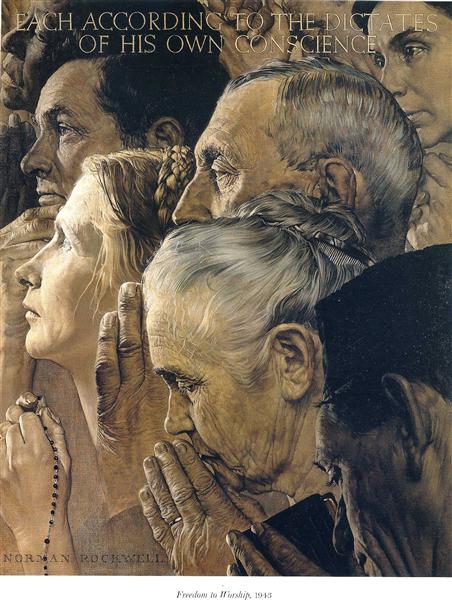
Featured Illustration – “Freedom to Worship” by Norman Rockwell
India is a secular country that is inhabited with people from different religions but the religious matter has always been a volatile subject in India both before and post-independence. The framers of the Constitution in the light of providing state neutrality as an important element of the Constitution introduced the concept of secularism and provided religious freedom to distinct religious groups. The Indian Constitution provides certain rights to every individual and religious sects of the country, to perform their religious practices. Firstly, Art. 25 of the Indian Constitution provides a constitutional right to every individual to profess their religion. Secondly, Art. 26(b) of the Constitution, gives special protection to religious denominations to manage their own affairs in matter of religion. However, where Art. 25 provides the right to all individuals, Art. 26 is restricted to religious denominations or any section.
The practise of excommunication is defined as “the expulsion of a person from any community of which he is a member depriving him of rights and privileges which are legally enforceable by a suit of civil nature.” Excommunication is done to protect the religious institution from the ‘dissidents’ and ‘schismatics’ who may negatively affect the religious schemes and practices and thereby pollute the very life of the religious institution. There has been a long-standing debate about the constitutionality of excommunication but the Courts have ruled in its favour. In this article, the author will be discussing the issue of excommunication with respect to the individual rights against the rights of the group to manage their own affairs. Furthermore, an analysis of the important cases has been done to prove how the individual right to profess their own religion has been affected because of such group supremacy and how excommunication must be allowed only in the rarest of cases.
AN OVERVIEW OF JUDICIAL CHALLENGES
The case of Sardar Syedna Taher Saifuddiin v. State of Bombay (1962) arose from the state of Bombay passing the Bombay Prevention of Excommunication Act which sought to put an end to the practise of ex-communication. The Act declared all forms of excommunication to have no effect in the eyes of law and penalised any person who tried to practise ex-communication. As a necessary implication of the Act, the rights of the petitioner who was the head priest of the Dawoodi Bohra Community who could excommunicate uncooperative members from the community were taken away and he felt it obstructed his right to manage the affairs of the community.
The majority in the case held that the purpose of ex-communication was to maintain discipline and strengthen the solidarity of the sect. Article 25(2) permits the state to enact laws for the social welfare of the society, however, the impugned Act which takes away the right to ex-communication based on any ground including the religious grounds cannot be said to promote “social welfare and reform.” It is important to note that the majority admitted that the practise of excommunication does affect the civil rights of the concerned individual but the same is of no consequence because Art. 26 is only limited to the public order, morality and health. A contrasting remark was made in the case of Shirur Math (1954), where the Supreme Court decided that the State under Art. 25(2)(2) can legislate for social welfare and reform even if such laws interfere with the religious practices.
Furthermore, in Goolrokh Gupta v. Burjor Pardiwala (2017) the Parsi trust refused a woman who was born Parsi to enter into ‘Fire Temple’ and ‘Tower of Silence’ on account of her marrying someone outside her religion. 5 Judge Bench held that a Parsi woman, who was born and raised as a Parsi and has performed the essential religious ceremony would cease to be a Parsi after she marries a Hindu or a person from any other religion under the Special Marriage Act. Therefore, she will be assumed to have acquired the religious status of her husband until a declaration of her practising Zoroastrianism is found out by the court with an inquiry. The dissenting opinion in this case was given by Justice Khureshi, who said that it is the prerogative of the wife to decide if she wants to hold on to her religious identity after the marriage or not. The case of Sabarimala is another instance in which the group supremacy tried to take away the rights of the individual. The case relates to the ban which was imposed by Travancore Devaswom Board for women to prevent entry to Sabarimala temple. The ban was imposed to preserve the purity of the temple on account of menstruating women who were not supposed to enter places of worship. The practise was claimed to be devised keeping in mind the chastity of Lord Ayyappa, the presiding deity and not the misogynist views that they were blamed for.
The Kerala High Court decided that the entire restriction on the entry of women was not violative of the Art. 15, 25, 26 because such restriction was not imposed for women as a class but only on those women which belonged to the age group of 10-50. However, the Supreme Court gave a majority decision in the favour of the women who were prohibited to practise their freedom of religion. The majority opinion in the present case eluded that the exclusion of the women from entering inside the temple on account of menstruation took away their freedom of worship which has been constitutionally given to them under Art. 25(1) of the Constitution.
Justice Misra held that the devotees of the Ayyappa Community were essentially Hindu and didn’t pass the separate religious identity because the said collection of individuals were not ‘labelled, branded and identified by a distinct name.’ Therefore, the institution’s right to manage its own affairs under Art. 26(b) was subject to the laws made by the state which in the present case is the Kerala Hindu Places of Public Worship Act which allowed the places of public worship to be open to all sections and classes of Hindu. As these religious sects are Hindus, the practise of exclusion of women from the age of 10-50 does not pass the essential religious practices as under no circumstance can the practise be said to be an essential practise of the Hindu religion. Furthermore, the right under Art. 25(1) has got nothing to do with the gender or any other factors which are “specifically attributable to women.”
ANALYSIS
When we look into the cases as mentioned above, we see how in each case, there has been a conflicting interest between individual rights and the group supremacy to practise their religion and to manage the affairs of the religious denominations respectively. We must remember the point that was made by Ambedkar in the Constituent Assembly regarding how the individual is the fundamental component of the Constitution and the group exists to help the individuals to flourish.[1] The groups are itself limited to practise their autonomy to the extent that it does not cause harm to the civil rights of its members. However, it is to be kept in check and such rights cannot be allowed to work contrary to the Constitution’s ethics, especially when practices which are done in the name of religion are against the basic human principles. For example, the practise of ‘Made Snana’ which is a ritual where the devotees are made to roll over the leftover food of the Brahmans to help cure problems related to skin, marriage and infertility is an instance of such a group supremacy. The individual supremacy on the other hand often ignores the Constitutional rights given to the groups to decide what rules the individual of the groups must follow.
However, the author agrees with the dissenting opinion of Justice Sinha in the case of Sardar Syedna Taher Saifuddiin v. State of Bombay(1962) that excommunication is not entirely a religious practise and it involves important civil rights. Such rights include the right to profess his religion and right of being buried in the community burial ground which would get violated if a person is simply let to be excommunicated from the particular group. The court had to harmonise both the rights, i.e., the right of the individual and the community and in no case can one prevail over the other. Another problem that pertains to such issues is the fact that the judges are not well equipped with the religious matters keeping in mind the various religious practices in India and when such decisions are made, it becomes binding on the person whose rights may have been affected.
In a country like India, where everyone has a right to freedom of religion which is considered as something so complex and so diversified, the author feels that the court has taken a little lackadaisical approach towards such matters which is both discouraging and dangerous. When determining whether the practise of ex-communication is an essential religious practices from the religious point of view, the Court have taken powers into their own hand and transformed itself into a theological lord. It has trespassed its role as a constitutional authority by neglecting the civil rights of the individuals affected by excommunication. The case of Sabarimala which essentially prohibited menstruating women to enter the temple of Ayyappa is not a functional and right use of the power that the Constitution provides to the religious denominations to manage their own affairs. Though there exists no neutral position for the judges to balance out the rights because of the direct conflict of the constitutional right, it has to be seen that the ex-communication is practised in rare cases.
[1]The Oxford handbook of Comparative Constitutional Law 912 (2012).
Leave a Reply