
(Ayush Mishra is a practicing Advocate at Allahabad High Court. He is graduated from NALSAR University of Law, Hyderabad. This is the second part in a two part series)
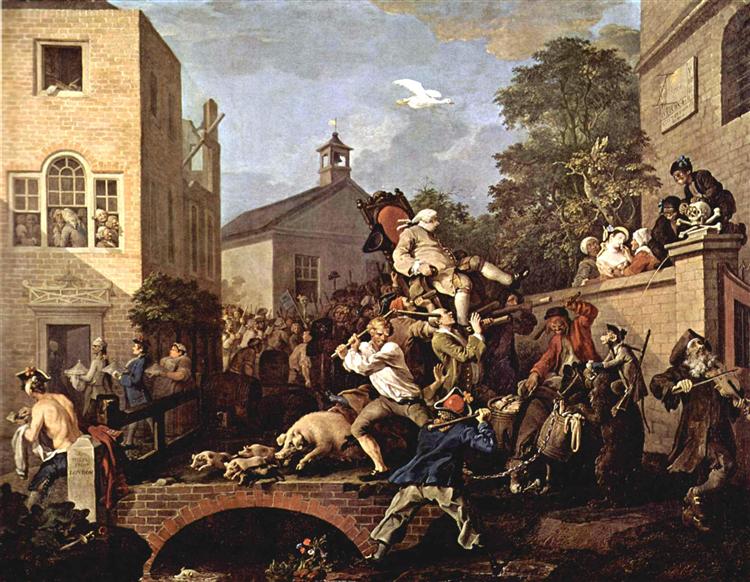
Featured Illustration – “The Triumph of Representatives” by William Hogarth
In Part-I of this blog, the author examined the Parliament Act, 1911, the Rajya Sabha debates and the Constituent Assembly Debates to scrutinize whether the power of the speaker to categorize a bill as ‘money bill’ is judicially reviewable or not. Part-II of this blog would continue this thread of inquiry by exploring contemporary scholarship and judicial pronouncements to argue that the Supreme Court must rectify its position in this regard and allow for judicial review of the classificatory power of the speaker under Article 110(3).
CONTEMPORARY SCHOLARSHIP
Leading constitutional law commentaries by Arvind P. Datar[1], Sujatha V. Manohar[2], H.M. Seervai[3] and S.R. Bhansali[4] have made a positivist and textual interpretation of Article 110(3), thereby reiterating the mere text of the Article and going on to hold that the decision of the speaker shall be final as envisaged by the article and there shall not be a possibility of Judicial review of such decision within the four corners of the text.
Pratik data, Shefali Malhotra and Shivangi Tyagi have argued that the constitution allows for the possibility of judicial review of the decision of the speaker by consciously not including the clause that the certification of the speaker “shall not be questioned in any Court of law”. Moreover, it has been argued by the authors that the case of Mohd Saeed Siddiqui v. State of UP was decided per incuriam as Article 122 provides protection only to non-compliance of rules and not to violation of constitutional provisions (in context: Art. 110(1)).
Additionally, an alternative interpretation of Article 122 is proposed by them. They divide the procedure followed by the parliament into three categories- “(1) procedure under rules of the respective Houses (Article 118); (2) procedure in a legislation enacted by the Parliament (Article 119); (3) procedure in the Constitution itself (Articles 109 and 110)”. The argument made here is that the constitutional procedures of type 3 are not covered by Article 122 and henceforth any violation of such procedures under Article 109 & 110 at the hands of the speaker shall not be protected by Article 122.
The authors have established that how the jurisprudential evolution by the Supreme Court of India is at loggerheads with the position adopted by other common law countries like the USA, Australia, South Africa, Canada and Pakistan. Additionally, they make an argument based on Article 255 which states that “any central or state legislation would not be rendered invalid because ‘some recommendations or previous sanction under this Constitution’ was not complied with.”. Based on this, they argue that the recommendation and sanctions mentioned therein can be held to be procedures and by implication, the word ‘procedure’ could be interpreted to mean just ‘recommendation and sanction’. But this is a feeble argument failing the basic test of syllogism as it cannot be validly held that if every recommendation and sanction is procedure, every procedure is recommendation and sanction only.
Dr. Anup Surendernath has taken a very distinct route to critique the Mohd Saeed case vis-à-vis other contemporary commentators. He argues that Mohd Saeed case follows the test laid down in Raja Ram Pal vs. Speaker, Lok Sabha & Ors. case which distinguished between irregularity and illegality. While other authors have erred in arguing that Mohd Saeed case was in contravention of the Ram pal case, Anup Surendranath has maintained that it was not contrary and that it had applied Ram pal case to reach the conclusion that categorization of ordinary bills as money bills constituted an irregularity and not illegality. His articulation is not flawed in the sense that it challenges this particular categorization and argues that that the application of the precedent in the correct manner would lead to the observation that it should have constituted illegality and not irregularity. Reiterating the decision of Babulal Parate vs State of Maharashtra, the authors interpret it to have given the constituent elements of “illegality”. However, such reliance can only be traced to the obiter of the judgement and not the ratio decidendi.[5]
He further takes forward the distinction between illegality and irregularity to make a argument that any non-compliance of a mandatory provision vis-à-vis a directory provision will lead to illegality and not mere irregularity and consequently will not receive the immunity of Article 122 and 110(3). The consequence test is used to cement the proposition that Article 110(1) is a mandatory provision and its non-compliance will lead to the automatic subversion of the federal structure of the Constitution and henceforth, Article 110(1) should be viewed as a mandatory provision. Building on this, it has been argued that the Mohd Saeed case was decided per incuriam as the violation of such a mandatory provision should have been led to constitute illegality and not mere irregularity.
Pratap Bhanu Mehta has opined that in a federal setup like ours, such bypassing of the upper house can be held to be nothing but the subversion of the ‘spirit of the constitution’ itself. Former Secretary General of the Lok Sabha, P.D.T. Achary, has noted that it is an attempt to erode and circumvent the Supervisory role of the Rajya Sabha by passing financial bills (in context: The Aadhar Bill) as money bills. Relying on Amarinder Singh vs. Special Committee, Punjab Vidhan Sabha and Ors , M. R. Madhavan has pushed for judicial review of the speaker’s decision and argued that when an act contains provisions other that “only” incidental to expenditure from the consolidated fund which is mandated by Article 110(1), the speaker cannot declare it to be a money bill and if he does so, the same should be judicially reviewable. Senior Advocate Arvind P. Datar has gone on to comment that “when the primary purpose of a bill is not governed by Article 110(1), then certifying it as a money bill is an unconstitutional act.” He even argues that “this trend of limiting legislative discussions and decisions of national importance within the space of the Lok Sabha must be swiftly curtailed.”. Commentator Smarika Kumar has noted that “experience with the Aadhaar Act reveals a structural concern regarding this classification process, which may have substantial implications in terms of undermining public and parliamentary deliberative processes.” Jeydev C.S says that in our context, the overarching principle is constitutional supremacy and not parliamentary supremacy. In the context of judicial review, he concludes that: –
“…the guiding principle should remain those broader grounds for review envisaged in Keshav Singh, Pal et cetera, rather than the assertions of Siddiqui and Jaiswal. The Supreme Court may very well follow Siddiqui and Jaiswal, but it should also take care to detail the contours of such a deviation from the collective wisdom of its earlier jurisprudence on judicial review of legislative procedure – and contend that the Rajya Sabha is thus relegated to legislative redundancy. Bereft of such reasoning, the article 122 standard and the consequential extension of judicial review to the Speaker’s decision under article 110 appears more constitutionally sound.”
JUDICIAL DEVELOPMENTS
Although the Supreme Court in Mohd. Saeed Siddiqui v. State of Uttar Pradesh and Yogendra Kumar Jaiswal v. State of Bihar has held that the decision of the speaker is not subject to judicial review, the broader understanding of the jurisprudence requires us to locate certain previous judgements of the court which are in favour of judicial review. The Supreme Court in Raja Ram Pal vs Hon’ble Speaker, Lok Sabha and Others considered the scope of judicial review and held that in spite of parliament being supreme in legislative matters, any proceeding which appears to be unconstitutional or suffer from substantive illegality, will not be accorded protection by article 122. The Supreme Court, while adjudicating on the scope of judicial intervention vis-à-vis speaker’s power in Kihoto Hollohan vs Zachillhu & Ors. observed that, though in our parliamentary democracy, a pivotal position is held by the speaker, yet the correctness of his decision can be inquired into by the courts and thereby holding that his decisions are subject to judicial review. The 2010 case of Ramdas Athawale vs Union of India made pointed references to the 1964 decision of Keshav Singh vs Speaker, Legislative Assembly which had held that judiciary has the power to examine the decisions of the speaker. The Court in Ramdas case further held that “if the parliamentary procedure is illegal and unconstitutional, it would be open to scrutiny in a court of law and could be a ground for interference by courts under Article 32, though the immunity from judicial interference under this article is confined to matters of irregularity of procedure”. It is also pertinent to note at this juncture that the more recent judgement of Y.K. Jaiswal which has reaffirmed the filed occupying judgement of Mohd. Saeed Siddiqui (which held that no matter how flawed the decision of the speaker is, it will only amount to an irregularity and therefore will be outside the scope of judicial review) is rationally not sound as it fails to offer “any independent assessment of the issue” and the only reason that it provides for reaffirming the decision is that because the Mohd. Saeed case held so.
CONCLUSION
Though a textual reading of the provisions tends to reinforce the view expressed in Mohd. Saeed case, contemporary scholarship has suggested that judicial review over the decision of the speaker must be allowed. However, the Constituent Assembly debates pose a hurdle to this assertion as the primary intention of the framers appears to be unfavorable to judicial scrutiny. Commentators have argued that the position of Mohd. Saeed Siddiqui v. State of Uttar Pradesh and Yogendra Kumar Jaiswal v. State of Bihar is not the correct position. The present bone of contention is presently before the Supreme Court in the matter of Jairam Ramesh vs Union of India and it is suggested that the Supreme court rectifies its position in this regard and allows for judicial review of the classificatory power of the speaker under Article 110(3).
[1] Datar, Arvind P. Commentary on the Constitution of India, LexisNexis, 1st Edition (2001): p. 454;
[2] Sujatha V. Manohar. Ed., TK Tope on Constitutional Law of India, Eastern Book Company3rd ed, p.592
[3] Seervai, H.M., 2015. Constitutional law of India: a critical commentary, Universal Law Publishing (Vol. 2). P. 2151
[4] Prof S.R Bhansali, The Constitution of India, India Publishing House, Volume 1, First Ed, 2007
[5] Which is made evident in the following paragraph of the judgement: – “We do not think that we need answer such a hypothetical question except merely to say that if an amendment is of such a character that it is not really an amendment and is clearly violative of Art. the question then will be not the validity of proceedings in Parliament but the violation of a constitutional provision. That, however, is not the position in the present case.”
Leave a Reply