
(Ravi Singh Chhikara is a third year student at Campus Law Centre, University of Delhi and Harleen Kaur is a fourth year student at Vivekananda Institute Of Professional Studies, Guru Gobind Singh Indraprastha University.)
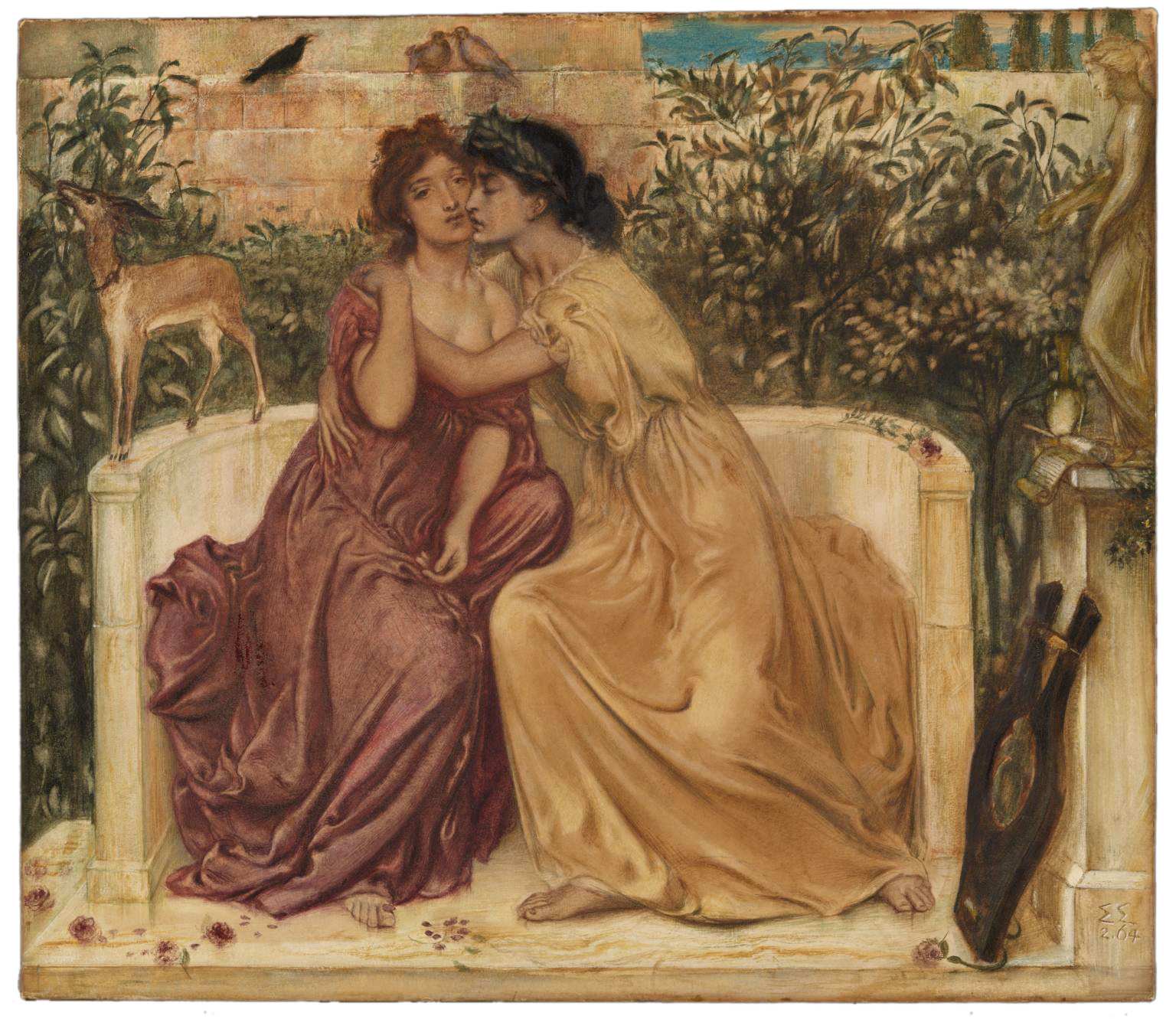
Featured artwork: ‘Sappho and Erinna in a Garden at Mytilene’ by Simeon Solomon
“Marriage is at once the most socially productive and individually fulfilling relationship that one can enjoy in the course of a lifetime”
Elden v. Sheldon, 46 Cal.3d 267
INTRODUCTION
Undoubtedly, a legally recognized marriage confers several legal rights and obligations that help a couple to live their lives to the fullest. It has been considered one of the significant constituents of individual liberty and has been recognized as a fundamental right under the Constitution of India and several other matured jurisdictions.
However, there is one particular community which is fighting a long battle in Indian courts to have this intrinsic and basic human right i.e. the homosexual community. In India, only marriages between a male and a female are given legal recognition under personal laws of every religion. Recently, a petition has also been filed in the Delhi High Court seeking a declaration that same sex marriages be recognized under The Hindu Marriage Act, 1955 and The Special Marriage Act, 1954. Interestingly, The Special Marriage Act, 1954, which is a secular code and intends to include as many people as possible, though allows inter-religious marriages, denies same-sex marriages. This article argues that, in the light of Navtej Singh Johar case, the provision that denies same-sex marriages under the Special Marriage Act, 1954 is unconstitutional. Since Indian courts have allowed the homosexuals to live in, it is certain that it will soon be facing an issue as to how to protect the relationships of thousands of homosexuals in our country. Thus, it needs to be assessed according to the present context of India.
NON-RECOGNITION OF SAME-SEX MARRIAGES UNDER THE SPECIAL MARRIAGE ACT, 1954
Section 4 of The Special Marriage Act prescribes the conditions required to be fulfilled to solemnize a marriage. Clause (c) of Section 4 reads“the male has completed the age of twenty-one years and the female the age of eighteen years”. The use of the word “and” expressly shows that the legislature intended marriage to be solemnized only between a male and a female. This can be inferred from the fact that the Act came into force in 1955 and the Supreme Court decriminalized the consensual sex between two adults of the same sex in 2018 (in the case of Navtej Singh Johar v. Union Of India). So, the consensual sex between two same-sex adults had been an offence under Section 377, Indian Penal Code from 1860 (enactment of Indian Penal Code) to 2018 Thus, it would be wrong to hold that Special Marriage Act, which came into force in 1955, allowed the same-sex marriages when even the consensual sex between the same-sex adults was an offence.Thus, as it stands, Section 4(c) has been construed as to allow marriages only between a biological male and female..
UNCONSTITUTIONALITY OF THE SPECIAL MARRIAGE ACT, 1954
The rights guaranteed under the Constitution are dynamic and progressive. They evolve with the evolution of society and with the passage of time. Therefore, it is necessary for the courts to interpret the constitutional rights in accordance with the prevalent conditions of the society and when any legislation is challenged as unconstitutional at any point of time, to examine it in the light of that judicial interpretation. In this article, the authors try to establish that after the joint reading of judicial interpretations developed in several recent case laws (cited hereinafter) for Article 14, Article 15, Article 19 and Article 21 of the Constitution of India, they are being violated by Section 4(c) of The Special Marriage Act.
- Article 14 – Article 14 of the Constitution of India requires the State to treat all the citizens equally. However, the State is allowed to make a classification between citizens if the following two conditions are fulfilled. First, the classification must be reasonable and not arbitrary. Second, the classification must have a ‘reasonable nexus with the object sought to be achieved’. Here, the legislature has made a classification on the basis of the ‘sex of one’s partner’. Persons who wish to marry the same-sex person are classified into a separate group from the persons who wish to marry with the opposite-sex person.This classification is clearly based only upon the ‘sex’ of a person. However, the current jurisprudential aspect of the Supreme Court views any classification which is based upon the ‘sex’ of a person as unreasonable.This jurisprudence was propounded in the case of Navtej Singh Johar wherein it was held that there is no reasonable classification between people who engage in intercourse with the person having opposite sex and people who engage in intercourse with the person having the same sex.
Moreover, it is a well-settled principle that the legislations which make classifications on the basis of sex should not be assessed only on its proposed aims but also on the basis of their ‘implications’ and the ‘effects’. Non-recognition of same-sex marriages constitutes discrimination that only stigmatizes the homosexuals and deprives them of all the rights which only marriage can confer such as inheritance rights in partner’s property, adoption rights, right to nominate each other as a partner in insurance schemes, etc. Thus, it violates Article 14.
- Article 15 – Regardless of how compelling the State has the justifications for treating a community differently, courts have from always regarded it legally and constitutionally wrong to treat a community unequally in absence of strong justifications. This can be inferred from the language of Article 15(1) of the Constitution which prohibits the State from discriminating against “any citizen on grounds only of religion, race, caste, sex, place of birth or any of them”. In the case of Navtej Singh Johar, it was held that there would be a violation of Article 15 on the ground of ‘sex’ if discrimination takes place on the basis of one’s sexual orientation. Here as well, in not recognizing the marriage rights of homosexuals, the discrimination is solely based upon the ‘sex of one’s partner’.For instance, a male who has a partner whose sex is ‘female’ would be allowed to marry but a male who has a partner whose sex is ‘male’ would not be allowed to marry. Thus, it violates Article 15(1).
- Article 19(1)(a) – Article 19(1)(a) guarantees the freedom of speech and expression. In the case of Navtej Singh Johar, it was held that “any discrimination on the basis of one’s sexual orientation would entail a violation of the fundamental right of freedom of expression.”It can never be doubted that a legal marriage is the only form which makes the union of two people acceptable to society. Thus, the denial of marriage rights forces the homosexuals to ‘hide’ their sexual orientation and marry someone unwillingly. Thus, it is violative of Article 19(1) because it inhibits in choosing a marriage partner.
- Article 21 – Marriage involves spiritual, emotional, and physical closeness. Undoubtedly, these are the private spheres of our life. Every person has the right to choose a soul-mate with whom one can pray for the well-being of other,share happiness, fears, anger, sorrow etc. It is the intrinsic right of everyone to share one’s life with the person of one’s choice because every person has different likes and dislikes and according to them, a person chooses his life’s partner.Denial of this right forces the person to form his/her likes and dislikes according to the will of the State. In other words, it is the State which decides the person with whom you can share your life’s spiritual, emotional and physical intimacy. This renders the life meaningless. Thus, ‘Right to Marry’ is covered under the aspect of ‘Right to Life’ which is a fundamental right guaranteed under Article 21 of the Constitution of India. Recently, in the case of Shakti Vahini vs Union Of India, Court expressly stated that the right to marry a person of one’s choice is integral to Article 21 of the Constitution of India. Further, in the case of Justice K.S. Puttaswamy vs UOI, it was expressly stated that “The autonomy of the individual is the ability to make decisions on vital matters of concern to life…….. family, marriage, procreation and sexual orientation are all integral to the dignity of the individual”. However, the right under Article 21 can be taken through a law which is substantively and procedurally fair, just and reasonable. But as it has been already established by authors that this provision violates Article 14, 15 and 19 of the Constitution and thus, cannot be held reasonable. The law which takes away all invaluable rights such as adoption, inheritance, etc. cannot be held reasonable at any cost.
INTERPRETATION OF SECTION 4(C) IN THE LIGHT OF TRANSFORMATIVE CONSTITUTION
Marriage is more than a commitment of two persons to live together. It brings with it a number of legally prescribed benefits and obligations such as inheritance rights in partner’s property, adoption rights, right to nominate each other as a partner in insurance schemes, etc.Moreover, enabling people to make life decisions in concert with someone enhance their own economic-being which also contributes to the society. It has also been observed that that in marriage, people learn to define themselves as caring rather than egoistic beings. As a result,they are more likely to contribute to the society. Thus, the marriage laws are designed to make it easy for people to marry each other. At the same time, divorce provisions are designed to discourage the easy termination of this union.Thus, marriage laws are to be interpreted on the belief that society will be best served if the right to solemnize marriage is available to as many people as possible. Based on this presumption, the courts should interpret the provision in the following manner: –
“that if both are the males, both should have completed the age of 21 years; if both are the females, both should have completed the age of 18 years; if there is one male and one female, the male should have completed the age of 21 years and the female should have completed the age of 18 years.” In case of transgender male and transgender female, Courts should adopt a uniform age of 18 years. Though different ages have been prescribed under marriages laws for heterosexual couples, authors strongly believe that Courts should establish a uniform age irrespective of gender. This would be in consonance with the recommendation made by Law Commission of India in 2018.
This interpretation would serve the true meaning of constitutional principles enshrined under Part III of the Constitution and the judgements cited herein before.
CONCLUSION
Undoubtedly, a homosexual person will have the same desire to marry as a heterosexual one. Just like any other couples, they will take care of each other in sickness and support each other in financial hardships, emotional depression, etc. Recognition of their right to solemnize marriage would not only serve individuals but society as a whole. This archaic provision in Special Marriage Act, 1954 is incompatible with the constitutional values and thus, should be struck down.. Further, other countries have already started conferring the right to marry to homosexuals and third genders. This compels the Supreme Court to take inspiration from these jurisdictions and recognize the right to marry irrespective of one’s gender.
In the NALSA case, it was rightly observed by the Supreme Court that “Social justice does not mean equality before the law on papers but to translate the spirit of the Constitution, enshrined in the Preamble, the Fundamental Rights and the Directive Principles of State Policy into action….”.
Leave a Reply