
(Adv. A. K. Ananda Krishnan is currently a Student (LL.M. Course) at Department of Law, University of Kerala)
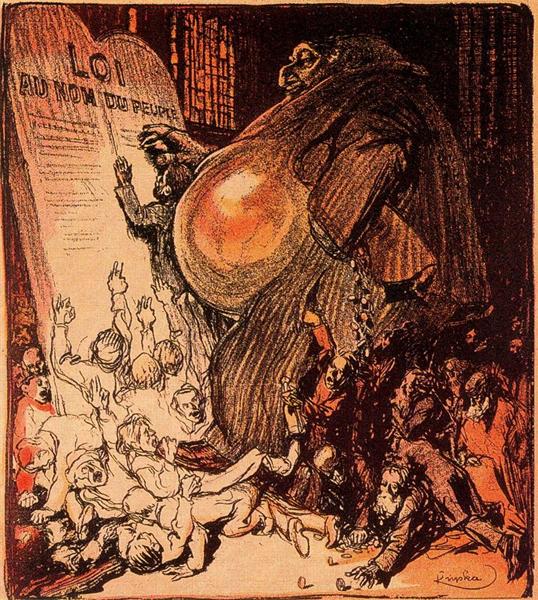
Featured Illustration – Equality (Money) by Frantisek Kupka
This is the second segment of a two part series examining the Apex Court’s contributions in effectuating classical constitutionalism in India. The first part pertains to the traditional concept of constitutionalism and how the Supreme Court enforced the same with regard to Parliament’s power to make constitutional amendments. The second part deals with the other domains where judicial activism was crucial in ensuring constitutionalism.
PROCEDURE ESTABLISHED BY LAW
One of the other notable instances where the Supreme Court went beyond the plain text of the Constitution in order to place limitations on the arbitrary exercise of power is concerning the interpretation of Article 21. Initially, in A. K. Gopalan v. State of Madras, the Court was of the view that the expression “procedure established by law” simply meant procedure prescribed by the law of the State. The argument that it stood for a just and fair law was rejected. It was then in Maneka Gandhi v. Union of India that the Court reversed its earlier holding. The Supreme Court raised the standard, for depriving a person of his life and liberty, from procedure established by law to due process of law. It was held that the law cannot be any enacted piece but it must necessarily be a reasonable one. The Court interpreted ‘procedure’ to be a fair, just and reasonable one, and not fanciful, oppressive or arbitrary. Instead, had the Court adhered to the literal meaning of the written text, then the State would have been free to put a person in shackles or take his life as long as there was an enacted law even if it was unreasonable. It was yet again timely judicial intervention that averted arbitrariness and secured constitutionalism.
REPROMULGATION OF ORDINACES
Another area where the Court demonstrated judicial vigour by placing fetters where there were none before is regarding the repromulgation of ordinances. In the case of D. C. Wadhwa v. State of Bihar, the Court ruled that repromulgation of a large number of ordinances time and again without presenting them before the Legislature would be a clear misuse of the extraordinary law-making powers, and held it as a form of a fraud on the Constitution. The remarkable feature of this decision is that had the Apex Court relied merely on the literal meaning of the provision, it would not have found any fault. But the Supreme Court instead looked at the intent of the provision to unearth the implied limitation on the exercise of the ordinance making power. The ruling stands testament to the necessity of the judiciary to give effect to constitutionalism considering the political tendency to find loopholes in constitutional fetters.
RULE OF LAW
But what becomes of constitutionalism after a proclamation of national emergency. Does the judiciary allow the government to wield unbridled power or would it still insist on some limitations? In A.D.M. Jabalpur v. Shivkant Shukla, the Apex Court by a majority of 4:1 held that Article 21 was the sole repository of the right to life and personal liberty and against the illegal deprivation of the same by the executive, and in the event of its suspension by a presidential order under Article 359, the Court cannot make an enquiry into whether the executive action depriving a person’s life or liberty had the requisite authority of law. The reasoning was that the Constitution is the rule of law and that there cannot be any rule of law other than the constitutional rule of law. It implies that there would be no constitutionalism in the event of a national emergency.
Khanna J., in his historic dissent, disagreed with the majority view and opined that the rule of law is the antithesis of arbitrariness which seeks to maintain a balance between the opposite notions of individual liberty and public order. He also observed that the principle that no one shall be deprived of his life or personal liberty without the authority of law isn’t a gift from the Constitution but one that existed and was in force long before the Constitution. The majority view in the ADM Jabalpur was later negated and the minority view upheld with the passage of the 44th Constitutional Amendment. In Justice K. S. Puttaswamy & Ors v. Union of India & Ors. the Supreme Court expressly overruled the majority view and opined that the right to life being inalienable to each individual existed prior to the Constitution and continues to be in force under Article 372. It was also observed that the recognition of this right to life by the Constitution would not make the Constitution the sole repository. It was also held that a civilized state under no circumstances can allow the deprivation of life or personal liberty without the authority of law. This judgment has strengthened the position of rule of law, which is one of the central tenets of constitutionalism, and thereby ensured there would be some limitations on executive power even during a national emergency.
FAILURE OF CONSTITUTIONAL MACHINERY IN STATES
The possibility of Article 356 being misused for political gain was foreseen by the framers, but the expectation was that the provision would remain a dead letter.[i] Contrary to this expectation, the Centre has indiscriminately invoked the provision to topple State Governments, who do not share the same political complexion. Nothing could have been a greater affront to constitutionalism than such a tyrannical exercise of power. Eventually, the Apex Court was compelled to intervene through State of Rajasthan v. Union of India, wherein it was held that the exercise of discretion, having an element of a policy, is examineable by the Court only if there is patent or indubitable mala fide or excess of power. Now it needs to be borne in mind that this decision was pronounced while the “ouster” clause, a provision that excludes judicial review of an act of the executive or another authority, inserted by the 38th Constitutional Amendment was in force. The Court’s ruling to place fetters in defiance of an express ouster of judicial review is not only admirable but indicative of its strong commitment to constitutionalism.
Turning to S. R. Bommai v. Union of India, the Court, no longer restrained by an ouster clause,[ii] showed no hesitation in holding the imposition of the President’s rule as violative of the Constitution. It was also held that the satisfaction of the President must be formed on relevant materials and not based on extraneous grounds. Federalism was ruled to be part of the basic structure of the Constitution and therefore the exercise of power under Article 356 cannot be at will. The Court by drawing up clear limitations ensured that the exercise of power is governed by law rather than by will and totalitarianism.
EXCLUSION OF JUDICIAL REVIEW
It is indisputable that the Supreme Court has been largely responsible for ensuring effective limitations on the exercise of power. This raises the question of how would constitutionalism fare if the judicial weapon used to ensure it is curtailed. It can be answered with absolute certainty that such a situation would be the death knell for constitutionalism. Fortunately, the Apex Court has been largely successful at defeating such attempts. In Indira Nehru Gandhi v. Raj Narain, Parliament enacted the 39th Constitutional Amendment to oust the jurisdiction of all Courts over election disputes involving the Prime Minister. The Court held that the exclusion of judicial review in election disputes was violative of the basic structure. It was also opined that the exclusion of judicial review was a negation of the right to equality.
In Waman Rao v. Union of India and I. R. Coelho v. State of Tamil Nadu, the Supreme Court, reiterating Kesavananda Bharati, unanimously held that while laws included in the Ninth Schedule before the Kesavananda Bharati case are immune from the twin challenges of Part III and basic structure, the laws included thereafter will be subject to judicial review and the basic structure standard. Ultimately by virtue of these cases, judicial review has been safeguarded and parliamentary attempts at escaping constitutional restraints discarded.
CONCLUSION
As evident from the discussion above, there has been no dearth of judicial decisions instrumental in securing checks and balances on the exercise of governmental power. It needs to be added that these are only a handful of landmark decisions and specific areas where the Apex Court has displayed its zeal for constitutionalism. Even so, it can be said, nary a doubt, that if constitutionalism has survived in India sans any age-old culture of constitutional values, it has been because of the Supreme Court, conscious of its role as the guardian of the Constitution, has time and again kept the legislature and executive within constitutional bounds. Though inconceivable now, were it not for the crucial interventions of the judiciary, we may have very well been living in a different India, unrecognisable from the one we are living in today, where we have been purged of our fundamental rights, where the secular character of our Constitution has been compromised, where State governments are indiscriminately dismissed, where large pockets of legislative, executive and quasi-judicial actions are immune to judicial review, and where an ordinance raj has made a mockery of the legislature. However, of late the Apex Court has seemingly shied away from confrontations with the government. Only time will tell if the Supreme Court will continue to champion constitutionalism or would it choose to hide behind judicial cowardice masquerading as judicial statesmanship. Be that as it may, just as there is always a need to teach physicians “First, do no harm”, in a true democracy there will always be the need of an institution to remind the government not to cause its people more trouble than it’s worth.
[i] Constituent Assembly Debates, Vol. IX, p.177.
[ii] The Constitution (Forty-fourth Amendment) Act, 1978.
Leave a Reply