
(Shivangi Pandey is a Fifth year student at University of Petroleum and Energy Studies, Dehradun)
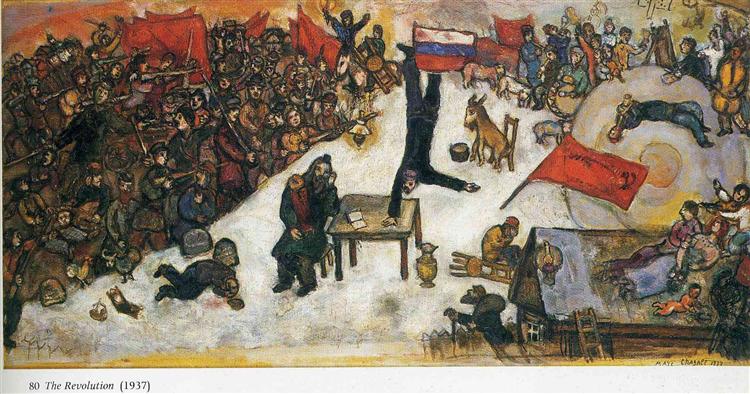
Illustrated Painting – ‘The Revolution’ by Marc Chagall
The theory of constitutionalism is a literature or rather a subject which has a profound engagement of transnational social movements. Any nation’s evaluation of their history and their current status is a testimony to this fact. Constitutionalism is a theory which has its origin from the traditional foundations of societal based methods which provide the background and the conducive surrounding for its evolution, growth and its changes. Globalization eventually led the transgression of boundaries and imposed a new era of structure of flow of ideas, virtues, and morals. Globalization was a phenomenon which transcended all man made prohibitions and inculcation of all as one created a new structure of world where there was no discrimination anymore. This new concept of shared commitment had its effect on all enterprises of the society and one of them was the spirit of constitutionalism. Along with the traditional practice of the evolution which involved the industrial aspects of the nation, globalization’s access to worldwide practices and mutual sharing of beliefs had a new perspective of this enterprise. The effect of western origin of this theory along with the conventional practices and incorporation of both of them together is the key to the spirit of constitutionalism of the modern world. This is how transformative constitutionalism functions under the spirit of global constitutionalism which adheres to the acceptance and adoption of theory from the societal movements across the world.
ARAB SPRING AND SPONTANEOUS HORIZONTALISM
In the evocative title of his 2012 book on “the new global revolutions,” BBC Newsnight economics editor Paul Mason asks “Why It’s Kicking Off Everywhere.”[i] Focusing on recent high profile episodes of social unrest, from the Arab Spring and mass demonstrations in Tehran to the eponymous actions of the Occupy movement, Mason charts the rise of a new form of political mobilization coordinated around social media and driven by technological innovation- “spontaneous horizontalism”[ii]. With respect to his analysis of this movement he tries to paint a picture of the realization and demand of citizens for a new structure of politics and democracy in the affected nations. Another aspect of globalization is of people eventually realizing and then leading the rise of a new structure of constitutionalism which though inspired from structures across the world, also realizes the needs of the people and thus the foundation is framed accordingly. In similar terms, commenting on the meaning of this global upsurge in rebellion and revolt, Mason argues that we are “in the middle of a revolution”[iii]. This means that capitalism and the traditional form of politics existing in the nations are to be ended and a new revolution is commenced with the terms of global existence. This revolution, he suggests, is reshaping established hierarchies, and as a consequence is “changing the balance of power between the leaders and the led”[iv]. This is the existing phenomenon of global constitutionalism, the renewed version where the ones who have been given the power realize their obligations towards the State and its people. In the spirit of awareness people across the world realized it, acknowledged it and have already started paving the way for the adoption of a new form of constitutional enterprise.
Perhaps the most striking aspect of his analysis is that few in the citadels of power, whether Arab dictatorships or corporate boardrooms, saw this coming[v]. This explains as to how those in power have realized the evolution and have accepted that with the new enterprise they can’t enforce the institutional structure on the people anymore. Accordingly, he speculates that at the present juncture—and reversing historical trends—those at the bottom, armed with their tweets and blogs, may have the advantage of being more in tune with the times than those in authority, whose monopoly of official force often proved futile in maintaining their hold on power[vi]. The uprisings of 2011 which reflected the buried up conflicts since years and dynamics which forced the creation of a new paradigm of governance and continue to pressurize political and socio-economic structures even today are some of the many examples of the idea of creation of an order and leading the change.
This is the testimony to the shift observed worldwide in the theory behind constitutions. This new shift observes and rejects the traditional belief where every form of self-constitution was considered to be legitimate. This is the new semantic shift of the 20th century which clearly holds that there is one common characteristic observed in all the constitutions globally which were “Model” or “Legitimate” was that all of them were similar in nature. This eventually led to the notion that not all constitutions were legitimate. This common analysis, comparison is entailed as a relevant aspect of global constitutionalism and provides that these similar characteristics can be both procedural and substantive in nature. They can have limitations on use of state power to avoid arbitrary situations as well as providing a set form and technique for the constitution of the Government and its power execution. These procedural and substantive norms were, in turn, an articulation of a “higher law” of the community of nations, reflecting a global communal consensus evidenced in common practice or international agreements. The notion of a higher law suggested a necessary universalism with roots in both natural and religious law[vii].
NEW INTERNATIONAL ORDER: 20TH CENTURY:
The century saw a movement away from a consensus, however tenuous, that constitutions were necessarily expressions of the internal social, political, and economic choices of a unique, territorially-bounded, political community.[viii] Constitutionalism in the twentieth century was tied to the construction of a collective—an international society of states[ix]—with the object of universalizing standards of behavior and of preserving the power relationships within and among states from threats[x]. This was observed under the lines of creation of peace organizations at international level to finally put an end to continued arrays of conflicts and wars. There were nations who opposed the compliance to western constitutional principles, but when it came to initiating peace treaties and assistance provided for economic development nearly all nations agreed to such proposition.
This is the new international ordering of spirit of constitutionalism which realizes the new format i.e. the transnational constitutionalism which intends to protect both State sovereignty as well as the normative values of the State as a whole. Under this system all states participate in the construction of universal normative constitutional standards, but none control it entirely (though some have a greater authority in the process—a nod to power), and all are technically subject to its strictures as international law (or as a means of legitimizing domestic governance against internal or external threats)[xi]. This structure is clearly demonstrated in establishments like UDHR & ILO which work for their respective goals in accordance with their target audience irrespective of any discriminations.
This new international obligation reflects the objective of global constitutionalism which is basically aimed at creating a new understanding and sphere of adoption of the theory of Rule of Law on all states globally. This created another instance of domestic understanding of constitutionalism where transnational principles which provided for adoption of universal necessities like rights and justice for everyone. It provides that powers of states should be limited and that benefits under the sphere of global constitutionalism should not be limited to those who are in majority power. This establishes that any arbitrary or immoral conduct by those in power should not be inflicted upon those who are not in power. Late twentieth century constitutionalism represented an attempt to systematize, institutionalize, and implement as international higher law, a long-held view in western legal and political circles of the basis for establishing a hierarchy of states by reference to their civilization[xii].
THE IDEA OF “BEYOND THE STATE:
Constitutionalism in it’-s essence envisages the conceptions of continuity of constitutional attributes and knowledge which fall beyond the state as per the international legal structure. This process occurs with a gradual shift of constitutional thought. Earlier, the analysis of the intricate structure of State based paradigms reflected the lack of cohesive strategy of world politics. The development of constitutional analysis of elements for and beyond the State is a discourse to resolve the existing issues like lack of cohesion and adhere to the evolution led by globalization. It forms the analysis which prohibits theories of constitutional exclusivity and adopts principles of transnational engagement, transplantation of constitutional principles set forth by the respective nations.
One of these ideologies is supranational constitutionalism which paints a definition of the world order in the presence of globalization. According to Neil Walker, whose work provides the most extensive and systematic treatment of supranational constitutionalism, its point of departure is a series of developments associated with globalization which mark the transition from one phase of sovereignty to another[xiii]. This theory provides for the end of plurilateral supremacy of power and lays emphasis on creation of a symmetric relationship. Multinational governance and the attributes of a promoted constitutional supranational body is the defining factor of supranational constitutionalism. This situation is compounded by changes in the techniques of governance practised by supranational bodies, which emphasize, for example, their reliance on networks and rule by experts[xiv].
The other aspect of this new world stage is transnational engagement and transplantation. This aspect is the phase of comparative constitutionalism where barriers of the nation-state ideology are broken and the constitutional practices around the world are acknowledged and then imbibed into their own principles. The national laws, international laws and their effects on the world are analyzed and lead to an engagement at a worldwide level. This reflects the connection of international law and constitutionalism. The cultural barriers along with the societal ones are mitigated by this engagement and transfer and adoption of philosophy “beyond the nation-state” structure.
In order to have an adequate discussion of the issue of global constitutionalism, a detailed analysis of the merits of this theory with reference to traditional and modern structures is utmost important. The result of the evolution led by the process of globalization, affected constitutional principles as well and the impact of this effect would be analyzed in the next part of this blog.
Concluding this part, globalization has clearly led to create and establish a new world order eliminating nearly all boundaries and form of discrimination. The spirit of humanity and creation of a united front to deal with woes of every human, are the main objective behind the theory of global constitutionalism. The creation of an international legal structure uniting all is the main point of discussion in this part.
[i] Paul Mason, “WHY IT’S KICKING OFF EVERYWHERE: THE NEW GLOBAL REVOLUTIONS”, (2012).
[ii] Mason, Idem ,44-46.
[iii] Mason, Idem ,3
[iv] Mason, Idem,83
[v] Mason, Idem, 25
[vi] Mason, Idem, 65
[vii] Dale Patrick, “Old Testament Law” 7 (1985)
[viii] Westel W. Willoughby, The Fundamental Concepts of Public Law 30 (1924)
[ix] Martti Koskenniemi, The Gentle Civilizer of Nations (2001)
[x] R.J. Barry Jones, Globalisation and Interdependence in the International Political Economy 50 (1995)
[xi] J. Schnably, Emerging International Law Constraints on Constitutional Structure and Revision: A Preliminary Appraisal, 62 ,U. Miami L. Rev. 417, 479–88 (2008)
[xii] Emer de Vattel, The Law of Nations: or, Principles of Law of Nature, Applied to the Conduct and Affairs of Nations and Sovereigns (Joseph Chitty ed., 6th ed. 1883) .
[xiii] Neil Walker, ‘Late Sovereignty in the European Union’ ,Sovereignty in Transition, 9-10, (N. Walker ed. 2003) .
[xiv] G. de Búrca and J. Scott, Law and New Governance in the EU and the US , (2006).
Leave a Reply