
(This post is written by Raj Shekhar and Ujjwal Singh. Raj is a student at National University of Study and Research in Law, Ranchi and Ujjwal is a student at Chanakya National Law University, Patna)
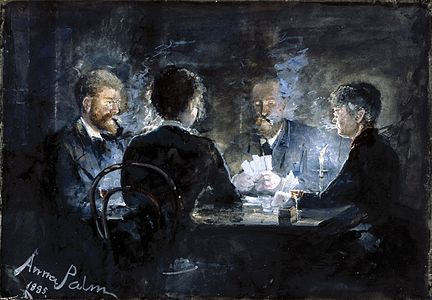
Featured Painting – “A Game of L’hombre” by Anna Palm de Rosa
‘Even so every good tree bringeth: forth good fruit; but a corrupt: tree bringeth forth evil fruit. A good tree cannot bring forth evil fruit, neither can a corrupt tree bring forth good fruit.’
On 24 August 2017, a nine-judge bench of the Supreme Court in the case of Puttuswamy v. Union of India declared that the right to privacy is a fundamental right protected under Part III of the Constitution of India. While primarily focused on the individual’s right against the State for violations of their privacy, this landmark judgment has repercussions across both State and non-State actors and over time has led to the implementation of a comprehensive law on privacy. With the changing times, humanity has leapt forward and from being a social animal, man has witnessed a paradigm shift towards ‘individualism’. As a result of this, the concept of privacy has been an issue of prime concern and has emerged as a legal right with a strong national as well as international presence.
However, as a commonly accepted fact, such rights are not absolute but are subject to certain reasonable restrictions. The discussion surrounding these restrictions become especially arduous when the admissibility of illegally obtained evidence in a criminal trial is concerned. Thus, the basic question that needs to be dealt with is as to whether the law enforcement should be allowed to violate the privacy of the individual to obtain evidence, which may lead to his conviction, and such illegal means would not affect the admissibility of the evidence, or should follow the reform the existing approach of Indian Evidence Laws and look forward to the reasoning of US Courts? The main contention dealt in this article revolves around these questions and by a substantial analysis of ‘Doctrine of Poisonous Tree’ and the judicial trends nationally and internationally, the articles try to put forth a strong recommendation for reforms regarding admissibility of evidence across Indian Courts.
Admissibility of Illegally Obtained Evidence in India vis-à-vis Indian Evidence Act
When we analyse the existing provisions under the Indian Evidence Act, 1872 which deals with provisions relating to admissibility of the piece of evidence, we find that no provisions exist which deal with specific ruling out of evidence obtained by illegal means. The courts have also not aided much in this, and have taken a view that as there exists no law or legal sanction that excludes relevant evidence on the ground that they were obtained under an illegal search or seizure, or was otherwise illegally obtained there exists no justifiable reason for their being ruled out from court proceedings. Illegally obtained evidence is evidence obtained during an illegal search or seizure of goods, or entrapment. Evidence obtained improperly may, for instance, be evidence obtained in breach of an individual’s privacy or where information is surreptitiously downloaded from a computer.
The protector of Rights, i.e. The Supreme Court of India, which is known for its pro-rights image has also spoken contradictory to its image and has held that “It will be wrong to invoke the supposed spirit of our Constitution for excluding such evidence. It, therefore, follows that neither by invoking the spirit of our Constitution nor by a strained construction of any of the fundamental rights can we spell out the exclusion of evidence obtained on an illegal search.” For adding to the reliability of its stance, the apex court has in the case of Ramjibhai Kalidas v. I.G Desai, Income-Tax Officer, and Ors. stated that such reasoning is even followed by the English courts, which is indeed true. However, the irony is that even though SC has relied on certain English judgments, the British courts themselves have distanced from the rationale of those judgments. This questioning of admitting such ‘tainted’ evidence was very elaborately dealt with in the case of Her Majesty’s Advocate v P (Scotland) where the court deliberated on various aspects of this issue and even considered the Salduz principle. However, though no firm course of law seems to have been laid yet a clear shifting trend has been observed since then. Another major development has been the development of ‘The Unfair Operation Rule’[i] wherein evidences extracted by being unfair to the accused through illegal and unfair means can be excluded.
Further, it has also been held in the case of Pooran Mal v. Director of Inspection of Income Tax that the Indian Evidence Act, 1872 permits ‘relevancy’ as the only test of admissibility as per Section 5 of the Act, and secondly, no other provision of any law excludes evidence on the ground that it was obtained illegally. This issue of relevancy has often crept up and several instances exist where the court accepted evidence which was obtained by a prima facie breach of fundamental rights. The most prominent example is in the case of State (NCT of Delhi) v. Navjot Sandhu, where the court held that the question was no longer res Integra, observing that a tape-recording of a relevant conversation is a relevant fact and therefore is admissible under Section 7 of the Indian Evidence Act. From the above mentioned judicial rationale, it is evident that the court considers ‘relevancy’ the sole criterion for admissibility of evidence and not the means through which it was obtained, thereby allowing even evidence obtained illegally to be admissible as long as they are ‘relevant’.
Doctrine of Poisonous Tree: Admissibility of Illegally Obtained Evidence in the US
The ‘fruit of the poisonous tree’ doctrine finds its origin and substance from verses in the Gospel of Matthew, which are present in the New Testament. Its present usage in Judicial verdicts can be traced back to being coined by Justice Frankfurter of the United States Supreme Court in the case of Nardone v. United States, where the Court held that since the evidence presented were illegally obtained and in direct violation of the Communications Act of 1934, their admission was annulled. This doctrine is part of the court-made ‘Exclusionary Rule’ laid down in the case of Weeks v. United States and contends that any evidence and postulates that are illegally obtained evidence are prima facie inadmissible in court, which was later extended in the case of Mapp v. Ohio to be used in case of evidence in criminal trials as well. However, before we can discuss further, we need to analyse the US court’s rationale behind such a strict rule.
The judicial reasoning behind the introduction of such a rule is simple, the preservation of the right of privacy which is envisaged under the 4th Amendment of the American Constitution. It deters law enforcement officers from acting in their drunk state of authority and overlooking the Constitutional safeguards endowed on every citizen. It’s something interesting to note that even today no parallel doctrines exist in India. Courts have time and again admitted evidence obtained through illegal means such as wiretapping, theft, cyber-attacks, etc.
The most recent example could be the case of Dharambir Khattar v. Union Of India & Anr, where the prosecution was seeking to use as evidence the material collected pursuant to the seven interception orders. However, according to the petitioner, the interception orders were passed purportedly under Section 5(2) of the said Telegraph Act, which were itself unconstitutional and, as a consequence thereof, the interception orders were void. Though the court concurred with the illegality of the orders yet pondered over the judgment in case of R.M. Malkani, where the Supreme Court, observed that ‘there is warrant for the proposition that even if evidence is illegally obtained, it is admissible’. Therefore, the court without going into the issue of whether there was non-compliance of the provisions of Section 5(2) or of Rule 419-A, held that even if there was, in fact, no compliance, the evidence gathered thereupon would still be admissible. This is the clear position settled by the Supreme Court and, therefore, no further question of law arises on this aspect of the matter.
Such cases are one in the chain of many others that have followed the same reasoning. The current legal standing holds that as long as the evidence is relevant and has probative value it is admissible and the Court can take it into cognizance without any bar. Therefore, the poisonous tree (Source) will cease to make a difference before the Judge as long as it gives fruits (evidence).
KS Puttaswamy Case: How the Judgment Affects Illegally Obtained pieces of evidence?
In India, the general notion is that evidence obtained by government authorities by illegal means, by surveillance mainly, remains admissible wherever relevant. A review of this line of precedent reveals that this body of law is built on a foundation erected primarily by three previous cases – MP Sharma and Ors. v. Satish Chandra, RM Malkani v. State of Maharashtra
and Pooran Mal v Director of Inspection (Investigation). The Supreme Court’s decision in State (NCT of Delhi) v Navjot Sandhu is the direct authority for the proposition that an illegally intercepted telephone conversation is and on the similar lines it can be used as an authority to justify other illegally obtained electronic pieces of evidence like emails, SMS, etc. However, with the Judgment in KS Puttaswamy case overruling MP Sharma and further overruling Kharak Singh, the prominent precedents establishing the admissibility of illegally obtained pieces of evidence have been absolved and thus a fresh perspective towards such pieces of evidence need to be framed.
To examine the existing admissibility rule it should be laid for testing before a constitutional court. The only way to do this would be by the filing of a writ petition by the person against whom illegal pieces of evidence have been presented and asking for a writ remedy for enforcement of the right to privacy, thereby restoring the status quo, by either returning and/or destroying of evidence collected in violation of such right and also prohibiting the prosecuting agency from using it further as evidence in the ongoing trial. However, such a request can be contested citing Section 5 of the IEA which permits for admissibility of such illegally obtained pieces of evidence and acts as a statutory authority. Even previously attempts have been made to deter such pieces of evidence by using Article 19(1)(f) [Right to Property(Repealed)] and asking for a return to the owner, but the move failed as even though the right did ensure the return, it in no way deterred the admissibility.
However, the pedestals have changed today and ‘privacy’ finds itself rightfully at an equal stand with ‘life and liberty’ (Puttaswamy Case). It has been established the surveillance action by the state is a major violation of the right to privacy enshrined under Article 21 and hence, logically flowing it shall also hamper the admissibility of any evidence obtained as a result of state surveillance action. Also, the fact that the Right to life and liberty as enshrined under Article 21 can only be deprived through a procedure established by law, the fact that the state while surveillance indeed encroaches upon area beyond the circumscribing limits of the law, would make it fail the test of proportionality, thereby evoking the safeguards aimed at protecting Article 21.
The test of proportionality means that when a public authority tries to fulfil particular goals which are his duties, the means of achieving these goals should be employed in such a manner that they in no way encroach upon the individual rights. Also, if encroachment is inevitable, such action should be tried to be maintained at minimum extent possible to preserve public interest and rights. Thus, the only respite would lie in restoring the status quo by return and/or destroying the evidence in question.
Individual Liberties and State Obligations: Antagonist Pair?
The major conflicting question that arises from all the arguments, precedents, and views above is whether individual liberty could be given such a high pedestal that it interferes with the state obligations? In other words, why cannot the state encroach on an individual’s liberty for – the greater good? The answer in simple words is to not negate the fundamental rights are not mere incentives conferred by the State on its citizens. Rather, they are fundamental in nature and ‘imposes restraints upon the powers vested in the modern State when it deals with the liberties of the individual’. This idea has been very recently demonstrated in the case of Vinit Kumar v Central Bureau of Investigation (2019), where the Bombay High Court ordered for the destruction of evidence obtained through illegal surveillance violating section 5(2) of The Telegraph Act 1885. This was done because the Hon’ble court was of the view that the admissibility of such evidence will make the fundamental rights look as naught. To support its claim, the court relied on the PUCL Case which was affirmed in the Puttaswamy Case and the potential violation of the Right to Privacy. Therefore, the Bombay High Court has affirmed the liberty perspective concretely. Also, as such an order amounts to an implicit reading down of Section 5 of the Indian Evidence Act 1872, it points to a consequent dilution of the default rule allowing illegal evidence into trials.
Undermining Liberties: Why India Needs to Streamline its Exclusionary Principles?
India has been known for its harsh stance on protecting the rights of its citizens however no rational reasoning exists which can explain the undermining of liberties by allowing for admissibility of illegally obtained evidence in Indian Courtrooms. When we go by the disciplinary principle it’s completely clear that it vouches for the exclusion of illegally obtained evidence, even when it’s reliable as well as relevant. This would be seen as an open discouragement from courts towards improper practices in the investigation of crime. Logically, such exclusions would ultimately undermine the value of improperly obtained evidence which would eventually put a stop to such practise.
Even if we look into the critical approach of things, the very fact that evidence obtained by infringing an individual’s right provides a prima facie justification for future infringements that would be made to obtain more of such pieces of evidence. Therefore, the exclusion of such illegally obtained evidence is one of the methods by which infringement of the right can be curbed in the future. There is no denying this doctrine indeed has proved beneficial to the guilty time and again. But then the question that arises is – Can a crime be a valid ground for Individual rights infringement? These debates have been making rounds ever since the post-independence era and as a result laws commissions have time and again recommended the inclusion of such exclusionary rules. For instance, the 1st Law Commission Report, 1956 stated that there was a gross misuse of power by the police to extract evidence.
Thus, it is the responsibility of the judiciary to wean out such evidence during court trials. Another example is the 94th Law Commission Report, 1983 which has duly admitted that with the growing global stress on human rights and subsequent expansion of Article 21 in the future, which indeed happened in the Puttuswamy v. Union of India makes it imperative to rethink the introduction of this doctrine of exclusion into the current legal framework of India. It is the sole duty of the legislature and judiciary to find ways in which a cogent balance between the fundamental right to privacy and the conflicting principles of the admissibility of illegally obtained evidence can be maintained. It needs to be understood that with the expanding of the scope of Article 21 which led to its inclusion of Right to Privacy as a fundamental right, the present conundrum falls in direct conflict with the fundamental right and hence a legislative inclusion of ‘exclusionary’ principles would be a welcome respite.
[i] The Unfair Operation Principle and the Exclusionary Rule: On the Admissibility of Illegally Obtained Evidence in Criminal Trials in India.” Indiana International & Comparative Law Review 27, no. 2 (2017): 147. Accessed 21 October, 2020.
Leave a Reply