
(Anirudh Tyagi is a second year BA LLB. (Hons.) student at Dr. Ram Manohar Lohia
National Law University, Lucknow)
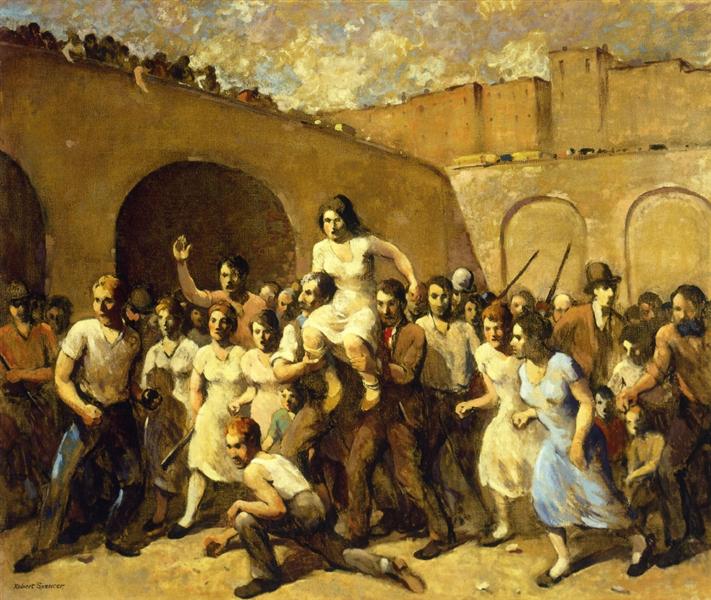
Featured Artwork: ‘The Seed of Revolution’ by Robert Spencer
The Supreme Court of India recently in Amit Sahni v. Commissioner of Police (hereinafter “Shaheen Bagh Judgment”) , where it allowed the administrative machinery to take action against protesters who block a roads indefinitely, has balanced the right to protest and the reasonable restrictions applicable thereto. The court relied on its judgment in Mazdoor Kisan Shakti Sangathan to balance the interest of the residents of an area to the interest of the protesters to hold demonstrations. The court however noted that the constitutional right of speech and expression enables the citizens to peacefully protest against the state.
This was in concurrence with the U.S Supreme Court’s decision in Thornhill v. State of Alabama (hereinafter Thornhill) where Justice Murphy remarked that “Peaceful picketing is free speech. Non-violent actions are like words.” However the US Supreme Court had also denied the existence of such a right “without just cause or legal excuse.” Thornhill was decided in 1940 and after a decade the Indian Constitution enclosed this principle under Article 19 which guarantees six freedoms of the citizens including the rights to “speech and expression” and to “assemble peacefully without arms.” The same article also provides restrictions on these rights on the grounds such as sovereignty and integrity of India, public order, morality, security of the state, etc. Each of these freedoms can be restricted by establishing the “reasonability” between the said restriction and the object it seeks to achieve.
In this article, the author would try to establish the balance between the rights of citizens to express themselves through demonstrations, and protests and the restrictions that the state could impose thereon. The author shall also contest how the Supreme Court’s verdict in Shaheen Bagh judgment is not only founded on Mazdoor Kisan Shakti Sangathan but was a necessary repercussion of enigmatic jurisprudence accommodated in many decisions on citizen’s right to protest.
Right to Protest and the Associated Intricacies
Freedom of speech and expression is ascribed in Article 19(1)(a). It corresponds to the First Amendment Act of the United States but with certain modifications. While the limitations on the exercise on such a right in U.S are to be explored on case to case basis, in India such restrictions are explicitly provided in Article 19(2). From the very starting, it was implicit that citizens have a right to dissent from or to demonstrate against the State. In a very early case of V. Vengan, the Madras High Court discreetly differentiated the right to demonstrate, even if non-violent, from initiating a “propaganda”. The court also mentioned that if two fundamental rights come in conflict with other, as were in this case, the courts would be slow to recognize and uphold such a right which violates another fundamental right. The court refused to drive analogy from Thornhill and said that in respect to right against discrimination, which is scribed in Article 15 of the Indian Constitution, the Indian and American jurisprudence are different as the latter does not provides any such right. This was a very interesting approach. This case was decided in 1951 and by then the Indian Courts were reluctant to establish a connection between different fundamental rights. The Supreme Court in A.K Gopalan v. State of Madras had already differentiated the “procedure established by law” in India from the “due process” of America and refused to read two fundamental rights together. This approach ended only after the Maneka Gandhi judgment in 1978. Had it been decided in complete accordance to Gopalan, the High Court would not have read two fundamental rights simultaneously and did not construe the right of demonstration liberally. The ratio of this verdict would find its shades in upcoming decisions and would encourage the Supreme Court in Himmat Lal (discussed later on in this article). In this manner, the methodology adopted by the Madras High Court in Vengan was ahead of its time and had engendered the liberal notions of judicial construction of Article 19.
The V.G Row Case
A landmark verdict of the Supreme Court in State of Madras v. V.G Row cleared the befogged understanding of permissions and limitations under Article 19. Article 19 works on the principle of “reasonability” but still there should be some substantial mechanism to effectuate some certainty. V.G Row attempted to resolve this conundrum. Indian Criminal Law Amendment (Madras) Act, 1950 allowed the government to declare an association unlawful without providing any ground of such declaration. The petitioner, who was the general secretary of a society that was declared unlawful by the government, had challenged the said Amendment as violative of his “right to form association” under Article 19(1)(c). The government contended that the said law banned the organization of the petitioner as it interferes with the maintenance of law and order and constitutes a danger to public peace. The society was accused of appropriating funds for unlawful purposes. The government therefore relied on “reasonable restrictions on the exercise of the right” and justified the impugned law on “reasonability”. The court was urged by the government to not to look outside the Article 19 and restrict itself to the principle of seclusion adopted by the Supreme Court in A.K. Gopalan. The court then wrote how the facts and circumstances in V.G Row are different from those in A.K Gopalan. The court said that in A.K Gopalan, the preventive detention was upheld because the constitution itself provides such a law in Article 22. This cannot be accepted with regard to Article 19 and a formula of subjective satisfaction of the government cannot override a basic freedom guaranteed to the citizens. Moreover, Article 19 works on the “doctrine of reasonableness” whereas Article 21 talks only about the “procedure”. Hence it can be implied from the decision in V.G Row that the scope of judicial scrutiny under Article 19 is wider than that in Article 21. The court invalidated the legislation on ground of being devoid of reasonability.
Supdt. Of Police v. Ram Manohar Lohia
In Ram Manohar Lohia (hereinafter “Lohia”), the petitioner who was the general secretary of the Socialist Party of India had given a widespread call for an agitation against the enhancement of the irrigation rate by the Uttar Pradesh government. While addressing the audience, he urged them not to pay the enhanced rates to the government. He was subsequently arrested and the City Magistrate remanded him for two days. Through an appeal, the case reached the Supreme Court. The constitutionality of Section 3 of the U.P Special Powers Act, 1932 that prohibits instigation to disturb the public order was challenged.
The court formulated a very intriguing question- Whether Section 3 of the U.P. Special Powers Act, 1932 is inconsistent with Article 19(1) of the constitution or does it qualifies the restrictions of Article 19(2)?
The court ventured to puzzle out the ambiguity of “public order”. It was however certain that “public order” is a wider phenomenon than the “security of the state” as settled in the Romesh Thappar case. In Lohia, the court referred to Romesh Thappar to ascertain the extension of judicial scrutiny which was purportedly decreased after the First Amendment Act. The court observed that there is a little line of difference between the terms “public order” and “public tranquility” and one should not be confused with the other. The court mentioned that “public order” is a ground for reasonable restriction but not “public tranquility’ or peace for that matter. The court found the dissenting opinion of Fazl Ali J. in Brij Bhushan of great help. According to Justice Ali, the phrase “public order” is wide enough to cover everything from a small affray to the “security of the state” and therefore the latter is a subset of the former in its widest sense. This view was endorsed by Subba Rao, J. who maintained that the “interest of public order” should also be reasonable enough to qualify the requirements of Article 19(2). The court therefore went for the “effect test” to check the reasonability instead of the “object test”. The government failed to establish any kind of intimation between the restriction imposed and the object it sought to achieve. The court, therefore, invalidated the impugned law and upheld the petitioner’s right to protest as a constitutional blessing. This view would further get strengthened in Himmat Lal with certain modifications.
The Ultimate Conclusion in the Himmat Lal Shah Judgment
Everything discussed above culminated into a satisfying doctrinaire of law in Himmat Lal. The court tried to limit the scope of “regulation” by the government. The court said that no law can take away the right to assemble on public streets. However the government was held entitled to limit the time and place of such procession in interest of the public order. Justice Mathew wrote that, “A public meeting, however reasonable and desirable its purpose may be, is a nuisance if it causes any appreciable obstruction, and that it is not necessary to prove that in fact, anyone has been prevented from passing.” (Emphasis supplied)
Justice M.H Beg, in a concurring verdict, said that “the right to hold public meeting at a public place may not be a fundamental right by itself, yet, it is so closely connected with fundamental rights that a power to regulate it should not be left in a nebulous state.”
In its judgment, the court held that there is nothing wrong if a public meeting is required to comply with certain requirements related to time and place of such meeting or peaceful procession. Nevertheless, such restrictions cannot place unqualified discretion in the hands of the administrative machinery.
The decision in Himmat Lal was relied on by the Supreme Court recently in a judgment where it reiterated that the right to hold peaceful processions is a fundamental right but the same should match the necessary requirements so as not to interfere with the fundamental rights of others.
Conclusion
A lot of protesters in Shaheen Bagh were arrested under the Unlawful Activities (Prevention) Act, 1967 (UAPA). UAPA empowers the state to declare those organizations unlawful which interfere with or disturb the law and order in the country. In order to contain arbitrariness, section 5 of the UAPA mandates the central government to constitute a tribunal headed by a High Court judge takes the final call on such unlawfulness. This tribunal was a necessary consequence of the “doctrine of reasonableness” propounded and construed by the Supreme Court in V.G Row.
The restrictions under Article 19(2) were majorly got tested in Romesh Thappar and Lohia. When the former differentiated public order from public tranquility, the latter espoused for a “direct and proximate nexus” between the restriction and the object it seeks to achieve. We have seen at the very start how the judgment in Vengan read the freedoms under Article 19 with relation to other fundamental rights. This was discussed to provide the reader with an understanding as to how the approach of Madras High Court was very similar to the principles of fairness and reasonability; which was later made mandatory after Maneka Gandhi. The liberal approach of Madras High Court helped the Supreme Court in Himmat Lal to balance the restrictions imposed by the executive and the right to protest. It not only pragmatically allowed the protests by proving government with the necessary latitude to regulate them but also scrapped the redundant discretion in the administrative authorities. This was a harbinger for many verdicts including the Mazdoor Kisan judgment of 2018 and the very latest verdict in Amit Sahni.
All these cases are sufficient to conclude that “doctrine of reasonableness” is the benchmark in disputes relating to protests and demonstrations. The author, in this article, has limited the discussion to protests where a large number of people were involved and which are normally referred to as the “public protests”. This is very different from demonstrations called by political parties and other unions. The author concludes that this series of judgments from Vengan to Himmat Lal ultimately strengthens the decades-old principle of Thornhill which has been strengthened in the well-founded judgment of Amit Sahni.
Leave a Reply