
(Chanchal Dhakad is a fourth year student and Piyush Soni is a second year student at National Law Institute University, Bhopal)
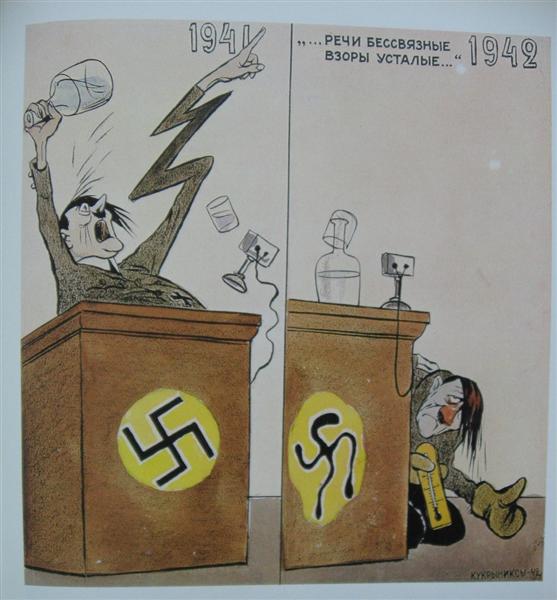
Featured Illustration – “Speeches incoherent, Tired eyes” by Kukryniksy
Owing to the changing times the needs and the wants of the people have also changed. Humans have started exploring new ways to make their lives easier. One such domain is the communication sector. For the past few decades, television and media have been the main source of information for the whole world, which now has been joined by a growing craze as well as dependence on the internet. The pandemic has increased this dependency manifold. All these things are primarily dependent on the regulation of airwaves. However, the regulation of airwaves has conundrums attached to it and has emerged as a challenge in front of the whole system.
Recently a division bench of Bombay high court while hearing a PIL, pointed out that since the broadcasters use airwaves, which is public property, they cannot be left without regulation. Freedom under Section 19(1)(a) (right to freedom of speech and expression) is not absolute as article 19(2) provides reasonable restrictions on article 19(1)(a) on grounds of public interests. These broadcasters use airwaves for broadcasting, which is public property. Hence, there is no absolute right to fare airwaves.
Echoing the same quandary, recently a PIL has been filed in the SC seeking the constitution of an independent statutory authority to regulate electronic media channels and facilitate the development of broadcasting services in India. A question “Whether it is not necessary to regulate the use of such airwaves in the national and public interest, particularly with a view to ensuring proper dissemination of content and in the widest possible manner” has also been raised regarding the use of airwaves.[i]
Considering the present discourse on the regulation of electronic media through regulation of airwaves, this article attempts to examine in detail, the need for regulation of airwaves; And whether such regulations result in putting a sledgehammer to Article 19(1)(a)[ii]of the Constitution? The article would further analyze whether the present norms (which predominantly are based on self-regulatory mechanisms) are anachronistic and provide a conclusion based on such analysis.
NEED FOR REGULATION OF AIRWAVES AND BROADCASTING
Talking about the contemporary scenario it is evident that several news channels are peddling fake news and propagating hate speeches in the name of journalism. They have become platforms to assassinate the dignity of an individual(s), or organization. These news channels are run by foreign/Indian investors with their own economic and political motives. Several news channels have been indulging in propagating hate speeches and abusive languages. The lack of regulations and statutes has provided opportunities to these uncontrolled and unregulated broadcasters to attack the foundation of unity and integrity of the nation.
One such recent example is the reportage of the Sushant Singh Rajput case by Republic Tv wherein it surpassed every limit of so-called “investigative journalism” and conspicuously acted as a parallel court. To the chagrin of society governed by rule of law, Twitter hashtag campaign of ‘#ArrestRhea’ was run by the channel. The question arises whether asking the public who should be arrested in a case be part of investigative journalism?
It is well established that there is a difference between informative media and trial by media[iii]. A trial by press, electronic media, or public agitation is an antithesis of the rule of law, it can lead to a miscarriage of justice.[iv] The courts have expressed their displeasure over journalists indulging in media trial when the matter was subjudice as it amounts to interference with the administration of justice.[v] Hence media trial on the matters subjudice should be subjected to checks and balance.[vi] Further, the right to life embodied in Article 21 is not merely a physical right but includes within its ambit, the right to live with human dignity.[vii] However, due to a lack of regulations, this right to dignity has been put in jeopardy. Several news channels have been engaged in making baseless personal attacks thereby violating a person’s right to dignity provided under article 21 of the constitution.
PRESENT STATUTES AND THEIR INABILITY TO REGULATE MEDIA
The nodal body for the regulation of the press in India is the Press Council of India (hereinafter referred to as PCI) which was established under the PCI Act of 1978. However, PCI does not have the power to review the functioning of electronic media like radio, television, and internet media because electronic broadcasting channels do not fall under the ambit of the PCI. As per the definitions mentioned in ‘The Press and Registration of Books Act, 1867’ the broadcasting electronic channels are not covered. Further, the anchors of these broadcasting electronic channels are not covered under the definition of The Working Journalists and Other Newspaper Employees (Conditions of Service) And Miscellaneous Provisions Act, 1955.
The Supreme Court in The Secretary, Ministry of Information & Broadcasting vs. Cricket Association of Bengal (hereinafter referred to as ‘Cricket broadcasting’ case)[viii] has also opined and advised the government that there shall be legislation for controlling the electronic media. But even till date, the basic law regarding the electronic media is the telegraph laws which are pre-electronic laws. “It is absolutely essential, in the interests of the public, in the interests of the freedom of speech and expression guaranteed by Article 19(1) (a) and with a view to avoiding confusion, uncertainty and consequent litigation that, Parliament should take steps to fill the void by enacting a law or laws, as the case may be, governing the electronic media”.[ix] The court strongly critiqued the long-held government monopoly over broadcasting in this country and noted that Indian broadcasting was being governed by archaic laws. The Indian Telegraph Act of 1885 was meant for a different purpose altogether. When it was enacted, neither radio nor television existed, but both these concepts were later sought to be fitted into the definition of ‘telegraph’.[x]
FAILING SELF REGULATION OF BROADCASTING
Today, electronic broadcasting channels in India are governed by mechanisms of self-regulation. One such mechanism is the News Broadcasters Association (hereinafter referred to as NBA) which has devised a ‘Code of Ethics’ to regulate television content. NBA has set up a private body called News Broadcasting Standards Authority (hereinafter referred to as NBSA) which is empowered to warn, admonish, censure, express disapproval, and fine the broadcaster a sum up to Rs. 1 lakh for violation of the Code. Broadcast Editors’ Association and News Broadcasters Federation are some other voluntary organizations. These associations have their self-regulatory mechanism. However, there are several broadcasters that are not members of these self-regulated associations. These groups govern through agreements and do not possess any statutory powers. The fact that their membership is not compulsory allows the privileged ones to manipulate and broadcast the news according to their economic, political and commercial interests thereby harming and not serving – the principle of plurality and diversity of views, news, ideas, and opinion. Even after having Justice A K Sikri, as the present Chairperson of the NBSA, recently during the hearing of the Firoz Iqbal Khan vs Union of India (Sudarshan News’ show controversial case), the Supreme Court chided the NBA over its laxity in enforcing its regulations. Justice D Y Chandrachud, the presiding judge of the bench, called the NBA ‘toothless’.[xi] Hence due to the lack of any regulating body, several news channels broadcast the news subsiding the interest of the general public. In the year 1997 and 2006 broadcasting bill was introduced by the Government of India which called for the setting up of a separate Broadcast Regulatory Authority of India (BRAI). However, these bills lapsed in the dark crevices of parliament. Therefore, to ensure the smooth regulation, it is imperative to have a statutory body empowered to regulate news broadcasters to ensure journalistic freedom, honouring, and respecting the freedom of speech and expression.
USE OF PUBLIC RESOURCES IN THE INTEREST OF PUBLIC
In the Cricket Broadcasting case, the SC gave the government contingent rights of custodianship over the airwaves and also declared airwaves as public property. The Public Utility doctrine propounded by Bentham has been a part of Indian law and finds application in the present case as well. Even though this doctrine has been applied in cases dealing with environmental jurisprudence, it has a broader application.[xii] It mandates the government to provide complete protection to the natural resources as a trustee of the people at large. The same principle has been reiterated by the Supreme Court in many cases where it has categorically held that natural resources are vested with the Government as a matter of trust in the name of the people of India; thus it is the solemn duty of the state to protect the national interest and natural resources must always be used in the interests of the country and not private interests[xiii].In the same judgment, SC directed the regulation of airwaves either by establishing a central independent authority consisting of members from both government and media houses and regulating the grant of licenses to other agencies, including the private agencies by government[xiv]. Such authority should be representative of all sections of the society and be free from the control of the political and administrative executive of the state.
CONCLUSION AND SUGGESTIONS
India is perhaps the only democracy where the broadcasting of news through airwaves remains a monopoly of the privately-owned broadcasters. Although the Cricket Broadcasting judgment mandated the setting up of a central authority for regulation of airwaves, the same has not been implemented till date. Hence, broadcast regulation should begin with the constitution of a broadcasting-based forum that would represent the public in the most comprehensive possible manner. The institutional forms and procedures of broadcast regulation should then be worked out by this body, rather than be assigned to it by the government.
Further, the legislation so enacted should be consistent with the right of freedom of speech and expression under Article 19(1)(a) and must contain strict programme and other controls such as the licensing powers to Independent Television Commission (ITC) and also the powers to sanction the broadcasters who breach licensing conditions, including the power of suspension and revocation of licenses, as has been provided in the Broadcasting Act, 1991 in the United Kingdom[xv] .
Further, the current complaint mechanism of NBSA can be made effective by granting it statutory recognition, and its powers be enhanced by bringing all the broadcasters within its ambit. The orders passed by NBSA should be made binding on all news broadcasters to ensure that all broadcasts conform to the agreed norms.
NBA’s Code of Ethics should also be given statutory recognition under the Cable TV Act in the same manner as the Code of Advertisements of the ASCI has been acknowledged and recognized in the Advertising Code in the CTN Rules, 1994.The government can also widen the ambit of the Press Council of India, to enable it to deal with the broadcast media and to tighten up its procedures so that its findings are minimally binding on the industry.
[i]Plea in SC for constitution of Broadcasting Regulatory Authority of India to regulate Electronic Media, available at https://www.livelaw.in/top-stories/plea-in-sc-for-constitution-of-broadcast-regulatory-authority-of-india-to-regulate-electronic-media-read-petition-160873 , last seen on 10/11/2020
[ii]https://indiankanoon.org/doc/1218090/
[iii] Manu Sharma vs State (NCT of Delhi) (2010)6SCC1
[iv]State of Maharashtra vs. Rajendra Jawanmal Gandhi (1997), 8 SCC 386
[v]M.P. Lohia vs State of West Bengal and anr.2005 (2) SCC 686.
[vi]Supra note 3.
[vii]Maneka Gandhi vs Union of India 1978 AIR 597, 1978 SCR (2) 621; Francois Carolie Mullin vs The Administrator, Union Territory of Delhi.1981 SCR (2) 516.
[viii] The Secretary, Ministry of Information & Broadcasting vs. Cricket Association of Bengal [(1995) 2 SCC 161]
[ix] Ibid
[x] Ibid.
[xi]Do you watch TV?’ SC asks News Broadcasters Association (NBA); calls it ‘toothless’, available at https://www.livelaw.in/top-stories/do-you-watch-tv-sc-asks-news-broadcasters-associationnba-calls-it-toothless-163161, last seen on 10/11/2020.
[xii]Reliance Natural Resources Ltd. v. Reliance Industries Ltd. (2010) 7 SCC 1.
[xiii] Ibid.
[xiv]Supra note 8.
[xv] Ibid
Leave a Reply