
(Jayalakshmi Sankar is a first year student at National Law Institute University, Bhopal)
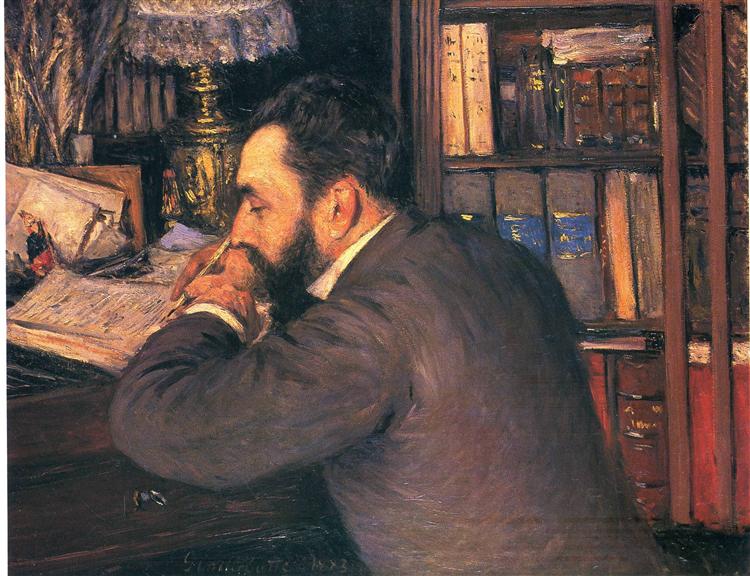
Featured Artwork: “Portrait of Henri Cordier, teacher at the School of Oriental Languages” by Gustave Caillebotte.
Recently, a Bhasha Bharatha Round Table Conference was held which adopted the “Bangalore Resolution”. The resolution urged the Central Government to amend Article 343 of the Constitution and bestow the status of Official Language to all the languages listed in the 8th Schedule. This calls for a much needed discourse on the linguistic policy adopted by India and its potential drawbacks.
Language has always remained a crucial determinant of one’s identity and culture since time immemorial. Multilingual countries of the world have their own unique approaches towards finding a middle ground in the battle between language as a source of individual identity and language as a means of national integration while developing their respective linguistic policies. India is no stranger to the concept of multilingualism and has also devised a linguistic policy keeping in mind the interests of different groups of people. Despite this, there seems to be constant discord among the people of the nation surrounding the special emphasis on Hindi.
This piece will scrutinize India’s current linguistic policy with special emphasis on the importance it has placed upon Hindi at the backdrop of the reasoning adopted by the Constituent Assembly for having Hindi and English as Official Languages. Additionally, it delves into the underlying issues with the 8th Schedule of the Constitution and the Central Government’s unchanged stance on this matter.
A Flawed Foundation
The Constituent Assembly of India was an indirectly elected body dominated by English educated, upper class members of the Indian society who didn’t completely understand the linguistic richness India possessed. After much discussion, Hindi in Devanagari script was adopted as the official language of India along with English as a temporary associate official language. This was known as the Munshi-Iyyangar formula since it was a compromise reached between the members who wanted only Hindi to become the official language and those who didn’t. Instead, it was decided that Hindi would be the official language along with English for a temporary period of 15 years. Following the expiration of 15 years, the Official Languages Act, 1963 was enacted and amended in 1967 to provide for English as an official language indefinitely along with Hindi. The same is enshrined in Article 343 of the Constitution.
It is to be noted that the reasoning behind picking Hindi as the official language was that it was the most widely spoken language with around 44% of the Indian population being regarded as native Hindi speakers and many non-native speakers also knowing it.
This forms the primary basis for deeming this reasoning to be flawed. Firstly, the statistic surrounding the majority of the Indian population speaking Hindi has been criticized multiple times for including people of other dialects and similar languages within the ambit of native-Hindi speakers. Secondly, out of the 13 dialects of Hindi spoken in India at that point of time, the dialect of Hindi that was deemed most representative of the country was Khadi Boli Hindi or the dialect spoken predominantly in the Delhi-Agra region, which was heavily influenced by Sanskrit. Despite such discrepancies, Hindi was chosen owing to the reason of it being spoken by a vast majority of the population.
Another reason for claiming this to be a flawed foundation is the wording of Article 351 of the Constitution, which states that Hindi shall draw inspiration primarily from Sanskrit and only secondarily from other Indian languages for its vocabulary. The reasoning provided was that Sanskrit was an ancient language that represented India’s culture since many Indo-Aryan languages draw their roots from it. However, the Constituent Assembly members seemed to have a false sentiment that Sanskrit is the mother of all Indian languages. In fact, many Dravidian and Tibeto-Burman languages have a unique origin and aren’t even remotely influenced by Sanskrit. There was no necessity to place such overarching importance on Sanskrit, which was a language that was spoken by nearly none and was close to being obsolete. Additionally, Sanskrit as a language also represented the caste discrimination that prevailed in India. It was the language which the Brahmins spoke exclusively thereby barring the members of the lower caste from learning it. As a newly democratic nation that emphasized on equality before law along with multiple other provisions for the protection of the lower castes, placing such high importance on a language that represented their oppression was deeply problematic. However, these did not seem to be the only causes of concern. In order to placate the non-Hindi speakers, the 8th Schedule was inserted in the Indian Constitution.
The Problem with the Eighth Schedule
The 8th Schedule provides that states may use any language listed in the Schedule for administrative purposes should they choose. Additionally, Hindi as the National Official Language would be further developed by including elements from the Scheduled languages. In an attempt towards strengthening the languages mentioned in the 8th Schedule and for the purpose of inclusivity, an obligation is placed on the Central Government to execute plans for the development of the Scheduled languages. Additionally, exams conducted for the Public Services could be given in any of these Scheduled languages. However, for all intents and purposes, out of over 19,500 languages spoken in India, only 22 of them find a mention in the 8th Schedule and share a position that is close to Hindi and English in terms of recognition and power.
Another noteworthy issue with the 8th Schedule is that there is no fixed criterion to determine what constitutes a Scheduled language. Sitakant Mahopatra Committee and Pahwa Committee were constituted for this purpose, but they both concluded that it was difficult to provide fixed criteria owing to the changing nature of dialects and languages. The consequence of this is that the recognition of language as a Scheduled language has become a question of popularity and political power. A broader picture would clearly project that tribal and indigenous languages have suffered a serious setback. For instance, while Sanskrit, which is spoken by very few was one of the first languages included in the 8th Schedule, tribal languages such as Bhilli and Lammi which are spoken by a much larger group find no mention.
The judiciary has also not provided any respite to these linguistic groups. The Supreme Court, while observing this discrimination noted with respect to access to public employment in VN Sunanda Reddy v State of Andhra Pradesh that any form of discrimination based on one’s language amounts to a violation of Right to Equality as enshrined in Article 16(1). However, since Public Service exams can be undertaken in any Scheduled language, those individuals whose mother tongue is not a Scheduled language are at a disadvantageous position and are discriminated against. Moreover, in Kanhaiya Lal Sethia v Union of India, the Supreme Court, in contrast to the aforesaid decision explicitly stated that the inclusion or non-inclusion of a language in the 8th Schedule is a policy decision of the Central Government and not within the jurisdiction of the judiciary. It went on to state that the Government’s decision to not include a language in the 8th Schedule does not violate one’s fundamental rights. While the water surrounding the violation of fundamental rights as regards the 8th Schedule is still muddy, the Schedule clearly seems to have unfairly benefitted a few languages as the Scheduled languages in India have gained recognition, power and the status of being mainstream languages.
Those languages which were unable to gain this status were thus given labels such as mere “dialects” or “tribal languages”. These labels have further exacerbated the prospects for lesser known tribal languages and have led them to the brink of extinction. People of these communities learnt the mainstream and widely spoken languages in order to get assimilated into the society and the better economic prospects it provided, thereby being forced to abandon their own culture. Thus, one can conclusively state that the insertion of the 8th Schedule has done equal harm as was stated in the preceding head. Despite this, the author feels that this is not a movement that has progressed in a “one step forward, two steps back” direction. While much is already debated regarding the 8th Schedule, the recent policies adopted by the government seem to invoke a larger debate that seems to go back to the drawing board.
Government Policy
It is clear that the term “Official Language” is not a euphemism for the word “National Language” and hence, the same ought not to be used as a window by the Central Government to force Hindi on to non-Hindi speakers through its policy decisions. Unfortunately, this has been done time and again by the Central Government when it pushed for Hindi to be recognized as an Official language in the UN more than once. This move was pointed out as arbitrary and unnecessary since one of India’s official languages has already been recognized as an official language in the UN. Additionally, the UN is a globally representative body and since Hindi is spoken in only a handful of countries outside India, it would bear no fruit in spending a large sum of money on getting it recognized. The then External Affairs Minister Sushma Swaraj stated that it was an effort to popularize Hindi worldwide. But the question that begs to be answered is why popularize Hindi as a symbol of India when there are over ten thousand other languages that are also spoken by Indians?
Another instance of such force is the 3 Language Formula of the National Education Policy. The 3 Language Formula proposed that 3 languages must be learnt by all students in India with Hindi as a mandatory one among them. The 3 Language Formula in itself has been criticized for being ineffective and stressful for students. A point to be noted here is that, while it is a 3 Language Formula for non-Hindi students, it gets automatically reduced to a 2 Language Formula for students whose native language is Hindi thus presenting an unfair playing field for non-Hindi speakers. This was later amended to state that students may learn any 2 Indian languages along with their regional language. However, linguistic activists have pointed out that this would eventually lead to most students learning Hindi owing to a scarcity of teachers for other Indian languages. Thus, neither the judiciary nor the executive seem to take adequate actions to further the rights of the linguistic minorities and curb the rampant pro-Hindi agenda.
Conclusion
From the above analysis, it is undeniable that India’s current linguistic policy has a lot of room for improvement. Regional languages and mother tongues should not have to take a backseat owing to the persistent promotion of Hindi. While there is no one-size-fits-all solution to this issue, continuing the current policy could potentially erase several cultures as a whole. Language cannot be forced as a factor of national integration in a linguistically diverse nation; it will do the opposite of integration. A good starting point of change would be to set definite parameters for what constitutes a Scheduled Language and what constitutes an Official Language.

Leave a Reply