
(Ishan Ashish and Shreeyaan Shrivastava are law students at National University of Study and Research in Law, Ranchi (NUSRL) and Symbiosis Law School, Nagpur respectively.)
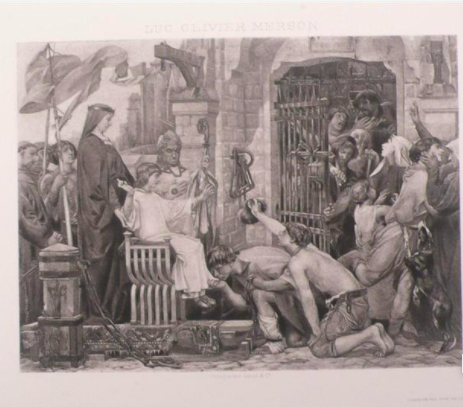
Featured Artwork: “Louis IX opens the jails of France” by Luc-Olivier Merson.
INTRODUCTION
After achieving Independence, the constitution-makers carefully crafted a constitution that gave the citizens various fundamental rights. These basic fundamental rights protect the human dignity and liberty of our citizens and make our constitution more humane in nature. One such right is the right to life and liberty. Our constitution under Article 21 envisages that “No person shall be deprived of his life or personal liberty except according to procedure established by law”; thus the right guarantees two things, firstly, the right to life, and secondly, the right to personal liberty.
Rights guaranteed under article 21 is a cornerstone provision of our constitution, and over the years, the scope of this article has been strengthened by our hon’ble courts. Recently, the Chief Justice of India N.V. Ramana expressed his concern over the degree of human rights violation in the police stations of our country. He stated that “the threat to human rights and bodily integrity is the highest in police stations”. The callous face of our country’s police stations has been exposed in several cases, wherein it has been alleged that the police force, disregarding the basic human rights of the citizens, have used third-degree torture to extract information. Most recently, the country was shocked and agonised when the reports of police brutality on the father-son duo came to light. There was huge backlash faced by the media and the police officials were eventually caught. However, not every case gets the same coverage and goes unnoticed by society. This article aims to highlight the lacunae that still exists in the system and how we can overcome it.
SCIENTIFIC EVIDENCE AGAINST TORTURE
Torture is a technique that is used to extract quick information from a detainee. Despite the popular opinion that torture techniques help to get a quick confession from hardened criminals, several reports now suggest that this perception is wrong and that these techniques are counter-productive. The argument is given against these techniques that while under affliction the detainees will give information, but the information given is not reliable, as torture generates a substantial amount of stress and physical injury which cause a catastrophic impact on the mind. There is absolutely no scientific evidence that torture or coercive methods work, rather, non-coercive methods are found to be more efficient. For instance, Goodman-Delahunty and colleagues conducted interviews of high profile detainees and several law enforcement officers, these detainees were involved in terrorist acts. They found that reported admission of guilt was four times higher when the interrogator was not using coercive methods. Despite all the evidence available, the police forces in India have been using these obsolete and barbarous techniques to extract information and sometimes using the techniques to such extremes that have resulted in the death of the detainee.
LEGAL PROVISIONS AGAINST CUSTODIAL TORTURE
The Indian Constitution and judicial system include several safeguards against custodial torture. These statutes, coupled with important judicial pronouncements have tried to ensure that the liberty and the rights of the detainee are not jeopardized. Some of the existing statutes are as follow
Ex-Post Facto Law Provides Protection Against Conviction or Increased Punishment: No person shall be convicted of any offence except for a violation of the law in force at the time of the commission of the act charged as an offence, nor shall any person be subjected to any greater penalty than that which might have been imposed under the law in force at the time of the commission of an offence, according to Article 20(1) of the Indian Constitution. In a nutshell, the article prevents the formation of a new offence that has retroactive application.
Right not to witness against himself: According to Article 20(3) of the Constitution, no person accused of any offence shall be compelled to be a witness against himself
Moreover, under section 24 of the Indian Evidence Act(1872), the investigating officer is prohibited from making any inducement, threat, or promise, but he is also prohibited from forcing any person to make any statement that he would like to make on his own free will under Section 163 of the Code of Criminal Procedure, 1973.
Furthermore, section 164(4) of the Code of Criminal Procedure, 1973 mandates the appropriate recording and signature of confessions, as well as a magistrate’s confirmation that the confession was made voluntarily.
Protection from Double Jeopardy: According to Article 20(2) of the Constitution, no one may be prosecuted and punished for the same offence more than once.
In addition, Section 348 of the Indian Penal Code, 1860, bans wrongful imprisonment to extort any confession or information to detect any infraction or misbehaviour.
In 2005, a new section 176(1)(A) of the Code of Criminal Procedure was added to the statute, requiring an investigation by a judicial magistrate or metropolitan magistrate in cases of death, rapes, or disappearances in detention; prior to 2005, such investigations were handled by executive magistrates.
Besides these existing statutes, the hon’ble courts have also made several important judicial pronouncements to safeguard the rights and to put an end to this draconian practice. One of the landmark cases on the issue is D.K.Basu v. State of Bengal wherein the court provided essential preventive measures that shall be provided to the detainees. These guidelines are considered to be of extreme importance as it helps in checking the abuse of police power.
EFFICACY OF THE EXISTING STATUTES AND GUIDELINES
As can be seen from the above, various rulings, orders, and guidelines have been made to increase openness and hold police officers more accountable. Despite all these provisions in our law, we as a country have failed to abate the number of custodial death. Without a doubt, these provisions have established valuable legal concepts and procedures that should, in theory, lower the incidences of death and torture, as well as the prosecution of responsible personnel, however, official figures of the National Crime Records Bureau indicate that 1,303 persons have either died or disappeared in police custody during the period 2005 to 2017. In India, five individuals die in detention on average every day, with many of them succumbing to police torture in court or police custody. The instructions are still mostly on paper because there is no regular follow-up mechanism. The existence of this inhumane practice is due to various reasons, firstly, the discrepancies that exist in the number of custodial death reported. For instance, the National Crime Records Bureau(NCRB) in the year 2016 reported just 92 custodial death, whereas the National Human Rights Commission reported 1,761, this is the instance of just the year 2016, however, this has been observed every single year and the cases have just increased substantially over the year. These major discrepancies have had huge implications as it makes it difficult to compensate the victim or victim’s family and it also impacts any policy formulation on the issue. Even when we consider that the recent reports published are accurate, the numbers are still staggering. In the recent reports published by NHRC for the year 2020-21(up to 28.02.202) the total number of custodial deaths is 1645. These egregious numbers depict an appalling situation of our system, these numbers not only raise questions on the integrity of our police forces from within the country but also brings disesteem from international human rights organisations.
Another reason that can be cited for these custodial deaths is that these custodial deaths are used to acquire a quick confession from the suspect. The total number of police personnel to the total number of cases in our country are significantly low, this is due to the understaffed police force. In 2020, according to the Home Ministry’s data, the number of police personnel sanctioned were 26,23,225 whereas the number of police deployed were 5,31,737. Due to the understaffed police personnel, the quality of investigation gets compromised as single police personnel gets overburdened by a large number of cases, hence, to expedite the investigation torture techniques are employed to get a confession.
Hence, despite the existing statutes, our country has been unsuccessful in abating custodial deaths and tortures.
SUGGESTIONS ON THE ISSUE/CONCLUSION
We as a country have always taken pride in the fact that ours is a constitutionally based country, wherein, everything is subject to rule of law. The inhumane and abhorrent practice of custodial torture, which leads to several custodial deaths, presents a regrettable picture of our country. The need to stop these custodial deaths is the need of the hour. To do so, some significant steps are required to be taken. The foremost measure to reduce these incidents is to reduce the number of arrests. The fact of the law on the matter is that arrests shall be made rarely. The courts have reiterated the above-mentioned point in several cases, observing that the arrest shall be made only on those cases wherein the arrest for the offence is seven years or more and that the officer is satisfied that arrest is necessary to prevent the accused from tampering with evidence. The Supreme Court in Arnesh Kumar v State of Bihar held that despite the offence under section 498A of the Indian Penal Code (IPC), which relates to torture for dowry, the arrest is not mandatory as per section 41 of the Code of Criminal Procedure.
Another method that can bring a change is to increase the number of police personnel. As pointed out above that the police force is understaffed, this increase will ensure that the investigation is conducted properly and torture techniques are not used to expedite the process. Also, the Malimath Committee Report and the Supreme Court in Prakash Singh v. Union of India has observed that there is a need to separate police maintaining law and order situation from police conducting an investigation as this would help in increasing the efficacy of an investigation and this is only possible if the state increases police personnel.
It is worth noting that India is one of the few countries that has not ratified, however, is a signatory of, the United Nations Convention Against Torture, which does not bode well for our country’s human rights protection. The 273 Law Commission report suggested that India should ratify the United Nations Convention against torture, which India signed in 1997. India does not have a stand-alone anti-torture law, and ratifying it would necessitate enacting one.
The IPC has several anti-torture laws, such as those dealing with inflicting bodily harm or grievous bodily harm to get confessions, criminal intimidation, and wrongful imprisonment. The existing statutes have provided safeguards against custodial torture. However, we have still been unsuccessful in reducing custodial deaths and tortures. A stand-alone statute would be a far better option for persuading our society and expressing our sympathy for the preservation of human rights and the prevention of torture. Separate legislation dedicated just for custodial death detailing the legal frameworks in accordance with the United Nations treaty will be a significant step towards ensuring the rights of the detainee. This has also been pointed out in Dr Ashwini Kumar vs Union of India.
As a result, much-needed legislative reforms are yet to be formulated. Furthermore, we have already witnessed countless examples of non-implementation of various recommendations as well as non-compliance with significant NHRC directions and guidelines. It just goes to show that governments at all levels are more comfortable relying on the police, which is usually regarded as the most crucial apparatus for running the government and assisting the political brass in completing their tasks, whether fair or unfair.
It is important to realize that the job of a state functionary is to do their best for the welfare of the society, especially when that state functionary is the police. Several steps have been taken to reduce the instances of custodial tortures and deaths, however, more needs to be done to eradicate the evil of custodial torture and protect the basic fundamental and human rights of the citizens.

Leave a Reply