
The author, Vedansh Raj, is a second year student at Rajiv Gandhi National University of Law, Punjab.
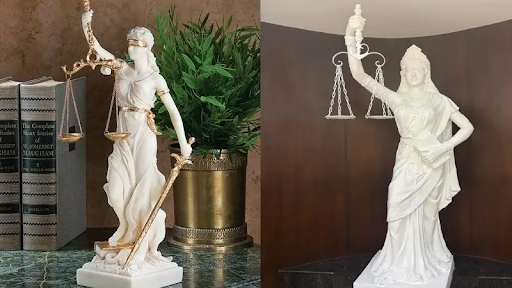
Featured artwork: Revamped statue of Lady Justice
‘Justice’ A new vision
The Supreme Court of India recently inaugurated the revamped statue of Lady Justice, which the British Government formerly presented. This newly crafted statue was commissioned by Chief Justice of India, D.Y. Chandrachud which reveals two significant alterations, firstly the removal of the blindfold and secondly, the holding of the Indian Constitution instead of the sword. The revolution in the realm of the Indian Judiciary, from traditional depictions to the growing emphasis on judicial transparency, accountability, and credibility, is marked by the abolition of blindfolds. In reality, the ‘uncovered eyes of Lady Justice’ can be a metaphor for the Doctrine of Open Justice which has substantially evolved historically in the judicial framework of India.
The Doctrine of Open Justice originates from the principles of Fundamental Rights, enriched in our constitution and most importantly under Article 21, which talks about the right to life and personal liberty. This doctrine asserts that justice should not be rendered in a vacuum rather it must be observable by others in the society. The Indian judiciary expanded the scope of Article 21 and observed that the right to a just and fair trial is covered under the ambit of Article 21 thus safeguarding the principle of open justice. In this blog, we will explore the rationale behind Lady Justice’s uncovered eyes, how the Indian judiciary bolsters this principle of open justice and the relevance of the evolving judicial transparency in the digital world.
Doctrine of Open Justice
The Doctrine of Open Justice places judicial proceedings under public scrutiny, thereby enhancing accountability and transparency within the judicial processes. Jeremy Bentham in his book Rationale of Judicial Evidence, outrightly said that “without publicity, all checks are insufficient: in comparison of publicity, all other checks are of small account.”, therefore recognising the remedial value of open justice. The Indian Constitution, which places the people at its core, effectively embodies this principle through the Doctrine of Open Justice. Recently, most court decisions have been made available for public scrutiny, a fundamental principle in many democracies, thereby ensuring that judicial power is exercised in an open and just manner
In interpreting Article 21 of the Constitution, the Indian courts have applied the Doctrine of Progressive Interpretation consistently adopting an expansive view that recognises the article as a source of various substantive and procedural rights for an individual. These rights encompass the right to a fair trial, the right to access justice, and the right to information and thus this doctrine serves as an essential principle within the Indian judicial system.
The landmark case concerning this doctrine in India is Naresh Shridhar Mirajkar v. State of Maharashtra where the court discussed the important principle of ‘open justice’. It was further held that this principle can be overridden by the inherent power of the court to hold trial in-camera if the ends of justice clearly and necessarily demanded it from the facts and circumstances of the case. Furthermore, Justice M. Hidayatullah, emphasised that “to maintain public confidence in the judiciary public access to judicial proceedings is a constitutional principle.” In the case of, Mohammed Shahabuddin v. State of Bihar, it was observed that “that open trial is the universal rule and must be scrupulously adhered to”. Lastly, Section 327 of the Code of Criminal Procedure (CrPC) is for an accused person which provides a right to a public trial. Hence, both these cases support the idea that if the Doctrine of Open Justice is not fully adhered to, there will be a miscarriage of justice, unless for exceptional circumstances.
Article 21 and Open Justice
With time, the scope of Article 21 is expanded by judicial interpretation where the judiciary has included transparency and openness in its approach. In Maneka Gandhi v. Union of India, the Supreme Court went a step further expanding the meaning of Article 21 by affirming that any procedure established by law must be fair, just and reasonable. This commitment to transparency was further reinforced in Prabha Dutt v. Union of India; in this case, the Hon’ble Supreme Court has clearly stated that media houses and the press have the right to report judicial proceedings. Besides, the idea which was laid down by the court was that the media houses as well as the public have the right to hear and cover the judicial process. This principle is also protected under the Constitution enshrined under Article 19(1)(a) which talks about the Right to freedom of Speech and Expression.
In 2018, the principle of open justice received its further development in Swapnil Tripathi v. Supreme Court of India, where the petitioner wanted the implementation of live streaming of the supreme court hearings, especially those issues related to national interest and security of India. The court granted the relief by affirming that live streaming of cases will be a step towards increasing transparency and consequently, there will be a development of public confidence in the judiciary system. This judgement is considered to be path-breaking in the events of open justice because the citizens would be able to experience justice in its actual proceedings via the live streaming process. Besides, it emphasises the applicability of this doctrine at a time when information technologies are increasingly used to facilitate greater openness.
Lady Justice’s Uncovered Eyes: A Symbol of Transparency
The increased levels of transparency are perhaps nowhere as symbolic as the recently demonstrated statue of Lady Justice by the Indian judiciary taking off the blindfold may be regarded as one more symbol which highlights that justice, is clear and impartial. Conventional representation through the Lady Justice statute means that justice does not discriminate but at the same time, it is blindfolded to external forces and social inequalities which are prevalent in the society. However, the redesigned statue now emphasizes that justice is no longer blind but transparent and clear to the general public. In today’s age, public trust in institutions hinges on their transparency, and this redesign represents a significant step toward ensuring justice is accessible and visible to all.
In Mohammed Shahabuddin v. State of Bihar, the court held that “the mala fide exercise of power and arbitrariness violates Articles 14 and 16 of the Constitution and to ensure justice and equality, public access to trials plays a crucial role in maintaining confidence in the judicial system.” In today’s time, the judiciary places a stronger emphasis on transparency and accessibility of justice, which was not as prominent in the past. The judiciary has evolved with the times, actively embracing the principle of open justice. While this concept was previously embedded in judgments, it was less known or accessible to the general public.
The uncovered eyes mean that the judiciary over time ceased being blind to the social injustices that are present in today’s society. Now, the reformed judiciary recognizes the inequalities that persists in the form of financial terms, power dynamics and cultural discriminations and gives them due consideration before passing appropriate justice. This approach ensures that justice is not only impartial but also responsive to the realities of the current time. It can be interpreted that the judiciary must now carefully ensure that all such disparities are addressed through a constitutional lens. Moreover, the lady justice holding the constitution rather than a sword gives symbolic meaning to a very drastic change of justice. It overemphasizes a new notion where justice is not merely a punitive measure but rather the enforcement of constitutional rights and the law as its supreme values.
Judicial Transparency in Digital Age: Challenges and Opportunities
It has been observed that there has been a shift in the dynamics of court proceedings and the relations of the courts with the public due to the digital revolution. Justice in contemporary times has not only served from the closed corridors of laws and legal structures but it has been radically transformed. It is more transparent today and judgments can be secured from the dedicated websites of the courts which are available to everyone. Noting the significance of technology the judiciary extended the practice of live-streaming in the landmark judgement of Swapnil Tripathi v. Supreme Court of India; thus, providing improved public access to justice. This development takes the courtrooms beyond the physical courts and allows the scrutiny of justice by the public; the justice which is served in a fair and just manner. However, these advancements within the court trials give rise to the privacy concerns which must be addressed. Potential pits in the doctrine of open justice might be the ones where there is a clash of this doctrine with the individual’s privacy.
However, for a better understanding of the issues in the present context, let us discuss the case of Justice K.S. Puttaswamy v. Union of India where the Supreme Court has observed that the right to privacy is a fundamental right. The judiciary is thus presented with the dilemma of properly interpreting the right to privacy against the background of the doctrine of open justice. One recent example of this dilemma is the issue relating to the release of the HEMA Committee report. In this particular case, the petitioners pointed out that the testimonies given by them which were included in the report cannot be published without their permission and this emphasizes that the conflict between privacy rights and transparency is an issue that needs to be observed by the courts. Furthermore, in the case of Kehar Singh v. State (Delhi Administration) it was stated that there should be no discrimination in public access to judicial proceedings and that the court should uphold the principle of respecting the right to expression under Article 19 of the Constitution. Therefore, the court should first; adopt a way which balances out the concerns related to individual privacy and the transparency of the judgements and second; lay down a procedure or guideline which can be followed in cases where public scrutiny clashes with Article 21.
Conclusion
The redesign of the statue marks a revolution in the Indian judiciary, symbolizing its embrace of transparency and accountability. The doctrine of open justice has been observed and refined by courts over the years, transforming colonial ideas of justice into one that acknowledges and addresses social inequalities.
As Frederick Douglass rightly said, “If there is no struggle, there is no progress.” after such change it is imperative that the doctrine may encounter challenges in balancing individual privacy but, the judiciary must find an approach that fosters greater public confidence. Justice must be served in a manner that is fair, just, and transparent.
Leave a Reply