
The author, Samarth Parag Gosavi, is a 3rd year student at Symbiosis Law School, Pune.
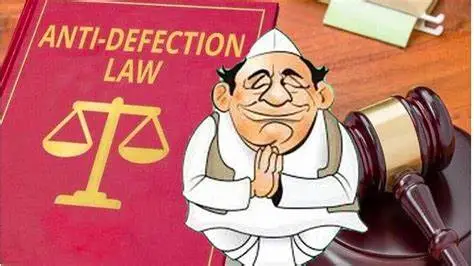
Featured Artwork: Racolb Legal
According to Association for Democratic Reforms Report, between the five-year period of 2016 to 2021, 443 MPs or MLAs defected and the toppling of governments in Goa, Manipur, MP, Karnataka, and Arunachal Pradesh. Keeping this in mind, this paper intends to give an account of the anti-defection law that is currently applicable in India, analyse certain aspects of the law, such as immediate disqualification, role of speaker and freedom of speech and expression and that of association, vis-à-vis anti-defection law, take account of the research done in this area and identify the gaps in research and finally, the paper also aims to propose some changes in the current anti-defection law. While looking at abovementioned aspects of the law, the author would also take account of the law in contemporary democracies.
What is Defection?
Defection in India is a pre-constitutional phenomenon. The defection of Shyam Lal Nehru and Hafiz Mohammad Ibrahim from the Muslim League to the Congress is an example of pre-constitutional defections. The defections for the reasons other than ideological ones have the potential to disrupt the democracy and considering this, several attempts were made after the independence to curb the menace of defections of MPs and MLAs. Accordingly, to curb the menace of defection, in 1985, 52nd amendment was made to the constitution of India by inserting 10th schedule. According to the paragraph 2 of 10th schedule, an MP or an MLA can be disqualified on the following grounds:
- If he voluntarily gives up membership of his political party.
- If he votes contrary to the party whip.
- If he is removed from the party.
- If despite being independently elected, he joins a political party.
- If despite being a nominated member, he joins a political party after expiry of six months.
To the grounds mentioned above, there was an exception in the 4th paragraph. If 1/3rd or more members of any political party split or merge with another political party, no action could be taken against such members. In the year 2003, 91st amendment was passed, increasing the number of defecting members from 1/3rd to 2/3rd, in order to attract the provisions of 4th paragraph of the anti-defection law. Moreover, this amendment removed the provision of split from the 10th schedule.
Analysis: Anti-Defection Law vis-à-vis Article 19
Immediate Disqualification:
Countries such as Bangladesh, Kenya, and Singapore provide that the seat of the member of house is considered vacant as soon as the member leaves the party on the symbol of which he was elected. Unlike India, these countries do not provide for an exception, depending on the number of members defecting. As is rightly pointed out by NS Gehlot, the law outlawed the retail defections and legalized the wholesale defections.
It is opined that the exemption under anti-defection law, which is based on the number of defectors, has a very little logical nexus with the idea of curbing defections.
Similar to India, Nepal has also made an exception under Nepal’s anti-defection law, exempting defectors, if their number amounts to 2/5th of total strength of their parent party. After the enactment of this law, as is noted by Krishna Hachhethu, the instances of split, factionalism increased among major political parties. This, even though, does not prove beyond doubt, establishes the probability that legalizing mass defections has nexus with the increasing instances of defections, and this probability, in the opinion of the author, is found very much true in case of India.
Role of Speaker:
Indian anti-defection law empowers the speaker of the house to take decisions as to the disqualification of members. This is criticized a lot for there is no concrete reason to attest that the speaker does not favour the political party he was affiliated with, prior to assuming the charge of speaker. The chair of the speaker is ideally expected to be apolitical, however, the country has experienced the instances where the speakers invented terms like ‘unattached members,’ and not the ‘defected members,’ belonging to no particular political party, allowing them to cast their votes. The court did not succumb to this argument and held that there is no phenomenon such as ‘unattached members.’
This is not the case in every single democracy. For example, article 66(4) of the Constitution of Bangladesh provides that the Election Commission must take the decision as to the disqualifications.
It is suggested that, this does not mean that speaker should be replaced by another body with immediate effect. It is suggested that the speaker’s jurisdiction to take the decision be kept intact, but be regulated by the judiciary by taking suo-moto cognizance of instances where the speaker delays his decision, beyond a period of time, which shall be specified in a code of conduct to be followed by the speakers of all houses. Such a code of conduct needs to be drafted.
The court may issue to the speaker, a writ of mandamus. Currently the judiciary can intervene only when the speaker has taken the decision. Further it is suggested if court issues a writ of mandamus to the speaker, it shall be followed by president/governor issuing a show-cause notice to the speaker. The show-cause-notice and the response to it must be made public, by mandating all newspapers to publish it. It must be understood that if there is anything which is dearest to the man after his life, it is his reputation. Publication of show-cause notice coupled with the other measures mentioned above, would threaten the reputation of speakers, and it would discourage them to a great extent, from favoring any particular political party by virtue of delaying the decision as to the disqualifications.
This suggestion should be implemented on pilot basis in a small state, and if found useful, should be tried on larger scale and if found unsuccessful, the author suggests that election commission be the authority to decide disputes as to disqualification, and the decision of disqualification be appealable in the Supreme Court.
What is clear is, the decision-making body must be an ‘apolitical body,’ as the court pointed out in Keisham Meghachandra Singh v. Hon’ble Speaker Manipur Legislative Assembly.
Freedom of Speech and Expression:
Paragraph 2(1)(b) of Tenth Schedule stifles the freedom of speech and expression of parliamentarians. Once a whip is issued by party, all members of that party, must vote in the house, only in accordance with the whip that is issued. As is rightly pointed out by Udit Bhatia in his paper “Cracking the whip: the deliberative costs of strict party discipline”, anti-cross voting provisions in anti-defection legislations do lead to stifling of dissent. Law Commission, in its 170th report, has expressed the helpless position of the law in this regard, and in the words of the commission itself, “we can point out only desirability aspect and nothing more,” since there is no law as to when a whip can be issued and when it cannot, and thus, issuing a whip has become an internal matter of political parties, leading to the decision as to whether the whip is to be issued or not, being left at the sole discretion of parties. It is pointed out by the same report, it is desirable that a whip is issued only when the matter affects the very existence of the government and not on every occasion. In the words of eminent and renowned lawyer Nani Palkhivala in his book “Our Constitution Defaced And Defiled”, to tell the legislators that once they are elected, they are ‘soulless’ and ‘conscienceless’ entities, to be driven by their political party and have no liberty to think for themselves.
Another aspect of parliamentarians’ freedom of expression is the way media portrays their defection. Indian media portrays defection as a ‘master-stroke’ by someone in a political party which the defector joins after his/her defection. We have also seen that, the term ‘Chankya,’ has been in trend, when the media reports the defections, and this trend, actually in a way, romanticizes the act of defection. US media however, portrays this as exercise of freedom of speech and expression. Such portrayal leads to recognition of parliamentarians’ freedom of expression, which is stifled by para 2(1)(b) of tenth schedule.
As far as the freedom of speech and expression is concerned, as mentioned above, law commission has expressed the desirability of whip being not issued in every single matter.
For bringing this desirability into reality, to the explanation of para 2(1)(b) of the tenth schedule, following words can be added:
2(1)(b)
Explanation: For the purpose of this subparagraph –
(c) ‘direction’ shall mean the direction issued on the matter which potentially impacts the very existence of government, and the members of political party in power, if vote against the government, the government may collapse.
Whether a particular matter potentially impacts the very existence of the government or not, is the question of fact and not that of law, and thus, to be decided by the judiciary from time to time.
Ultimately, we must recognize that members of house are elected by voters to voice out the voters and their constituency. Legislators, while in house, are representatives of their constituency and not of their political parties. If voting in a particular manner is in the interest of the legislator’s constituency but contrary to party whip and the issue does not pertain to very existence of government, the former interest, i.e., the interest of the constituency, must prevail over the later interest, i.e., the interest of the party.
Freedom of Association:
Article 19(1)(c) of Constitution of India provides the right to form the association. This freedom, no doubt, includes the right of disassociation. This issue came for decision before J&K high court in Damyanti Naranga v. Union of India. The court interpreted literally, and held that section 24(G) of J. & K. Representation of the People Act, 1957(similar to para 2(1)(a) of tenth schedule), does not take away the right under article 19, it merely says that exercise of that right in a certain way lead to losing the seat in the assembly.
There is very little attention paid to the freedom of association aspect of this law. The law, though it proscribes the dis-association with party once a person is elected on a symbol and support of a political party, it is not violative of article 19(1)(c), for this is the restriction that falls within the ambit of reasonable restrictions given under article 19(4), since 19(4) empowers state to make laws restricting this right in the interest of public morality. The defection of legislator relates not only to his personal morals, but to the morals of his entire constituency, for they voted him to the position, in most cases, on the basis of his party. The High Court of Jammu & Kashmir seems to have failed to notice this. At earliest opportunity, Supreme Court must strive to correct this.
Recommendations
Apart from the recommendations given in the analysis part of this paper, viz., the recommendation regarding speaker being the decision-making body, the amendment suggested to para 2(1)(b) of tenth schedule, author would like to suggest the following:
- The anti-defection law uses the term ‘Member of Parliament’ or ‘Member of legislative assembly.’ Thus, the anti-defection law is applicable only to the MPs or MLAs.
- In Constitutional Assembly Debates, hon’ble Dr. BR Ambedkar stated that oath taking is ‘part and parcel’ of constituting house.
These two points read together give the impression that the anti-defection law is not applicable to a person even if he is elected but not taken the oath, and thus, horse-trading immediately after elections, prevails. An amendment to that effect must be introduced to the anti-defection law.
In the light of this, it is suggested that the term ‘Members of Parliament’ and ‘Members of Legislative Assembly,’ be replaced by the phrase ‘person elected to the constitutional position of MP/MLA, whether or not given the oath of that position.’
Conclusion
The failure of the tenth schedule is pointed out articulately and rightly so, in National Commission To Review The Working Of The Constitution, A Consultation Paper on Review Of Election Law, Processes And Reform Options, when it said that “on an average more defections per year took place after the Anti-defection Law (10th Schedule) came into force than ever earlier.”
If we do not want the anti-defection law in India to be abused to even a greater extent, like it was brutally abused in South Africa until it scrapped its provision allowing defection during a 15-day window period in 2008, or in Israel, for lack of requirement special majority for passing the constitutional amendments, it is high time that we bring in the vital amendments to the law and ensure that it does not become vestigial organ in the body of democracy. The suggestions given in this paper are not claimed to be best and irrebuttable. These solutions can be put to debates and discussions; however, the key is to execute and implement the solutions that are arrived at.
Leave a Reply