
NOTE: This blog was originally published on 23 July 2020; however, it is being republished due to technical issues.
The Author, Shivank Verma, is an alumnus of the Hidayatullah National Law University, Raipur (shivankbhu12846@gmail.com).
Featured Image: The Hindu (Data Point) – 1/08/23
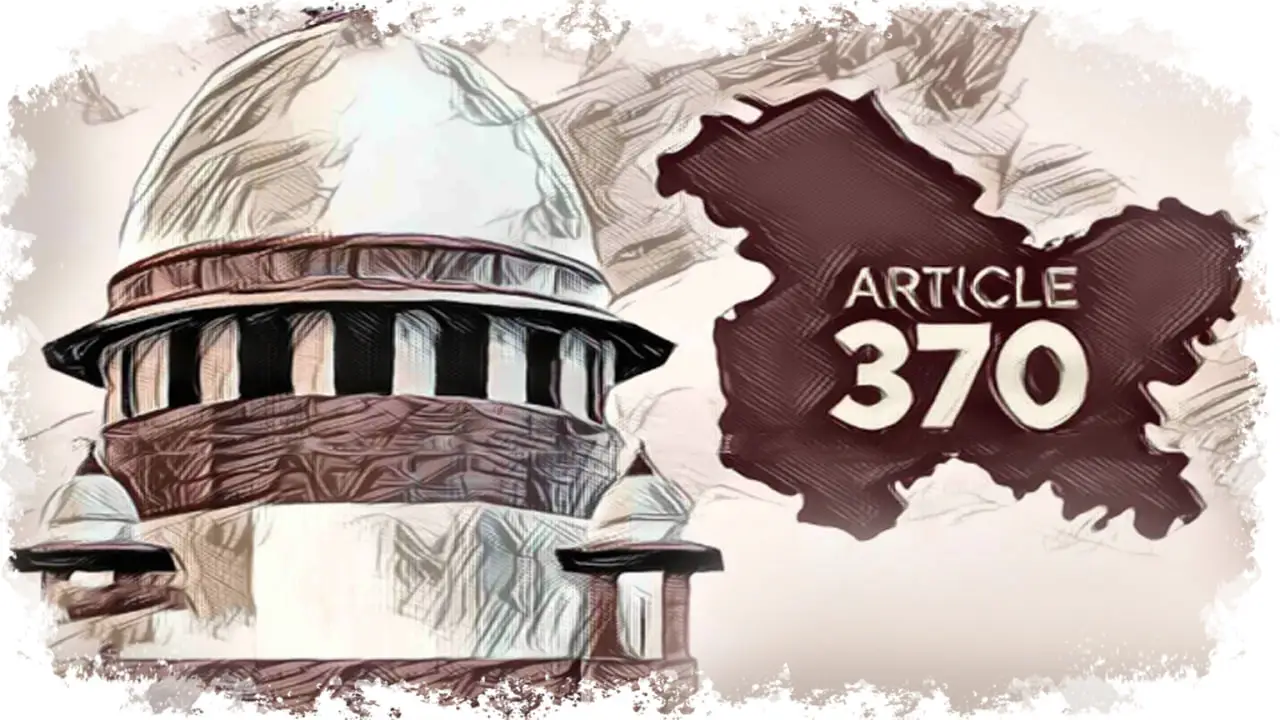
Article 370 has been one of the vexatious issues in the politics of the Jammu and Kashmir region and to a great extent, in the national politics. Various political parties for a long time had pitched for the abrogation of this particular peculiar Article which conferred a special status on the State of Jammu and Kashmir. On August 5, 2019, exercising its power under the erstwhile Article 370(1) of the Constitution, the President notified the Constitution (Application to Jammu and Kashmir) Order, 2019 (herein referred to as “C.O. 272”), which inserted a new clause in Article 367, triggering a complicated legal process with the result that the very next day all the provisions of Article 370 were made inoperative through another Presidential Declaration.
Article 370(3) of the Constitution of India empowered the President to declare the provisions of the Article inoperative. However, the proviso to the clause makes it mandatory that the recommendation of the Constituent Assembly of Jammu and Kashmir be obtained before such declaration is made by the President. The conventional opinion has been that since the Constituent Assembly of Jammu and Kashmir has ceased to exist, the President could not fulfill the requirement of the recommendation of the Constituent Assembly under Article 370(3), and therefore, Article 370 has acquired a permanent character.
C.O. 272 in a way dilutes this mandatory requirement; it amends Article 367, which contains provisions for how the Constitution is to be interpreted, inserting a new clause providing that the expression “Constituent Assembly of the State referred to in clause (2)” in Article 370(3) shall be read as “Legislative Assembly of the State”. This is a contentious amendment, and raises questions with respect to various issues including federalism, subversion of the Constitution and disregard of procedural law. One can raise objections with regard to the manner and haste in which the Constitutional Order has been effected, but the question is whether such an interpretation is even permissible, i.e., to construe references to the Constituent Assembly as the Legislative Assembly. To understand this, we need to look at the scheme and nature of Article 370 and examine the various principles of interpretation and test the validity of the C.O. 272 in light of these principles.
SCHEME AND NATURE OF ARTICLE 370
Article 370 was a unique article in itself as it was meant to be a temporary provision. The marginal note to the Article stated “Temporary provisions with respect to the State of Jammu and Kashmir”. Though Article 369 also contains temporary provisions having effect for five years after the commencement of the Constitution, no such time period was prescribed in the Article 370; secondly, Article 370 could not be amended by the procedure under Article 368 of the Constitution, as per the 1954 Constitutional Order. The only manner in which the Article could be modified was specified in the clause (3) of Article 370, which specified that President by public notification declare that the Article shall be operative with such modifications as the President may specify, the recommendation of the Constituent Assembly being necessary for such declaration.
Clause (1) of Article 370, inter alia, provided that the power of the Parliament to make laws for the State of Jammu and Kashmir would be limited to those matters in the Union List and Concurrent List which in consultation with the Government of the State are declared by the President to correspond to matters specified in the Instrument of Accession. The Schedule appended to the Instrument of Accession signed by Maharaja Hari Singh with the Dominion of India contained list of matters with respect to which the Dominion Legislature may make laws.The matters enumerated in the Schedule are listed under these broad heads :Defence, External Affairs, Communication, and other Ancillary Matters.
Further, the President might specify the provisions (other than Article 1 and Article 370) of the Constitution with such exceptions and modifications to be applied in relation to the State. Such an order, however, could not be issued except with the recommendation of the Government of the State.
It was in the exercise of the powers under Article 370(1) that the President made the Constitution (Application to Jammu and Kashmir) Order, 1954. This Order gave vast autonomy to the State of Jammu and Kashmir vis-à-vis other States. For instance, Article 3 of the Constitution provides that the Parliament may, by law, alter, diminish, increase the area or change the name or boundary of a State. Such a law does not require the assent of the Legislature of that particular State. However, the Constitutional Order of 1954 had inserted a new proviso to the Article providing that no such bill could be introduced in the Parliament without the consent of the Legislature of the State of Jammu and Kashmir.
Perhaps the most controversial modification that was made by the 1954 Order was the insertion of a new article after Article 35, i.e., Article 35A. These article allowed the Legislature of the erstwhile J&K to define permanent residents of the State, and any law made by the State Legislature conferring special rights on the permanent residents with respect to acquisition of immovable property in the State could not be declared void on the ground that it is inconsistent with the fundamental rights of other citizens of India. It can be seen that the power of the President under Article 370(1) is wide enough to even exclude the operation of Part III of the Constitution with respect to laws made by the Legislature of the State.
This special treatment to the State has been objected to by other States for a long time. When the draft Article 306A (which was incorporated in the Constitution as Article 370) was moved in the Constituent Assembly, Maulana Hasrat Mohani had objected to its introduction, “Why this discrimination please?”, he had asked. In the end, however, the draft article was adopted as a temporary provision taking into consideration the special circumstances under which the State acceded into Indian territory and the fact that the Kashmir dispute had been referred to United Nations. Moreover, the dissolution of Constituent Assembly in 1957 raised a procedural deficiency in so far as the Article 370(3) is concerned; the recommendation of the Constituent Assembly could not be obtained for making it inoperative, and the amendment under Article 368 could not have any effect on Article 370 unless applied by a Presidential Order under Article 370(1). This created a deadlock for several decades which could not be dealt with until now.
AMENDMENT OF ARTICLE 367 THROUGH C.O. 272
Exercising his power under Article 370(1)(d), the President made The Constitution (Application to Jammu and Kashmir) Order, 2019 (C.O. 272) on August 5, 2019. This Order makes two important provisions : firstly, that it the Order supersedes the 1954 Order and makes all the provisions of the Constitution of India applicable to the State; secondly, the Order modifies Article 367 to the extent that it inserts a new clause in Article 367, which is as follows :
“(4) For the purposes of this Constitution as it applies in relation to the State of Jammu and Kashmir–
(a) references to this Constitution or to the provisions thereof shall be construed as references to the Constitution or the provisions thereof as applied in relation to the said State;
(b) references to the person for the time being recognized by the President on the recommendation of the Legislative Assembly of the State as the Sadar-i-Riyasat of Jammu and Kashmir, acting on the advice of the Council of Ministers of the State for the time being in office, shall be construed as references to the Governor of Jammu and Kashmir;
(c) references to the Government of the said State shall be construed as including references to the Governor of Jammu and Kashmir acting on the advice of his Council of Ministers; and
(d) in proviso to clause (3) of article 370 of this Constitution, the expression “Constituent Assembly of the State referred to in clause (2)” shall read “Legislative Assembly of the State”.
Sub clause (d) of this clause is crucial. It provides that the Constituent Assembly of the State be interpreted as the Legislative Assembly of the State. The effect of such interpretation is that the procedural infirmity (that the recommendation of Constituent Assembly required under Article 370(3) could not be obtained) that existed in the way of the President to make Article 370 inoperative was removed, irrespective of the fact that the Constituent Assembly of the State had dissolved in 1957.
This interpretation is quite complicated. One serious objection put by the scholars is that the power under Article 370(1) cannot be used to amend the provisions of Article 370 itself. While, the C.O. 272 amends Article 367, in effect, indirectly it amends the content of Article 370(3). However, the Supreme Court has on a number of occasions has laid down that a party cannot do indirectly what it cannot do directly.[i] Therefore, C.O. 272 is unconstitutional in so far as it indirectly amends the content of Article 370(3).
The above objection can be resolved by resorting to the Mimansa Rules of Interpretation. The Mimansa is an ancient system of interpretation propounded by Rishi Jaimini. Its prime objective is to understand the Dharma (अथातोधर्मजिज्ञासा।).[ii] LaugakshiBhaskara in his commentary prescribes that after a child has memorised all the four Vedas, he is expected to undergo the study of Mimansa for a proper understanding and interpretation of Vedas.[iii] In the recent times, the Courts in India have started the application of Mimansa Rules in the legal usage.[iv] In Gujarat Urja Vikas Nigam Ltd. v. Essar Power Ltd, the Supreme Court observed, “Although the Mimansa principles were created for religious purpose, they were so rational and logical that they subsequently began to be used in law, grammar, logic, philosophy, etc, i.e. they became of universal application.”
One of the rules of the Mimansa is the Jatesti Nyaya or the maxim for the substitution of the Putika plant for the Soma Plant.[v] This rule arose due to practical difficulties in the performance of the yajnas. Often, the material prescribed for use in yajnawas not available in the vicinity. The nityayajnas however had to be performed as they were compulsory. The Jatesti rule or the rule of substitution resolves this difficulty as it states that if a material prescribed for a yajna is not available, then the nearest material can be used. Thus, if the putika plant is not available, then the soma can be considered a substitute. When a thing is enjoined for a certain purpose, another thing may be substituted which serves that purpose.[vi]
Now, under Article 370(3), the recommendation of the Constituent Assembly is mandatory for the President to make the Article inoperative. For the Jatesti Nyaya or the rule of substitution to apply, it is necessary that the act in question is compulsorily necessary. Is it necessary to declare Article 370 inoperative? The marginal note to the Article states that these are “temporary provisions”. Marginal notes appended to Articles of the Constitution are a part of the Constitution and can be used in their construction or interpretation, as the Supreme Court has previously held. As such, marginal notes reflect the intention of the Constituent Assembly. Therefore, the marginal note to the Article is indicative of the fact that the Constituent Assembly intended that the Article shall be temporary and shall cease to be operative in due course of time. Therefore, such an interpretation is to be preferred which gives effect to the intent of the Constituent Assembly. With the dissolution of the Constituent Assembly of Jammu and Kashmir, its recommendation could not be obtained for ceasing the operation of Article 370. However, as it has been seen, mere absence of prescribed material does not render the act impossible to perform, because a substitute can be employed in the performance of the act. As such, in the absence of the recommendation of the Constituent Assembly of State, its substitute, the Legislative Assembly of the State can be obtained for the President to declare Article inoperative.
It is submitted, therefore, that the reading of “Constituent Assembly” as “Legislative Assembly” is not an indirect amendment of Article 370, but an interpretation. Though the President cannot amend Article 370 itself under Article 370(1), that does not bar us from applying the rules of interpretation to fulfill the mandatory requirement of recommendation as contemplated under Article 370(3) to declare the Article inoperative.
CONCLUSION
The amendment of Article 367 through C.O. 272, can therefore be justified by locating it within the sphere of Mimansa Rules of Interpretation. The Mimansa Rules of Interpretation, therefore, present a more rational, scientific, logical and innovative system of interpretation. It is wide enough to cover all instances of ambiguity and can be employed to resolve many contemporary issues of law. In this instance, the Jatesti Nyaya or the rule of substitution can be employed to explain the interpretation of “Constituent Assembly” as “Legislative Assembly”.
However, this is not to say that the manner in which the provisions of Article 370 have been declared inoperative cannot be contested. The State was under President’s rule during the Presidential Declaration,therefore, effectively even the recommendation of the Legislative Assembly was not taken to declare Article 370 inoperative. This is clear from the wordings of C.O. 273, “…the President, on the recommendation of Parliament…”. The recommendation was actually of the Parliament itself. These are some of the serious legal issues which await resolution by the Supreme Court. The point, however, made out in this essay is that the interpretation of “Constituent Assembly” as “Legislative Assembly” through the C.O. 272 is legally permissible.
[i] Sonapur Tea Co. v. Deputy Commr.and Collector of Kamrup, AIR 1962 SC 137; Patel Motibhai Naranbhai and Another v. Dinubhai Motibhai Patel and Others, (1996) 2 SCC 585.
[ii] Jaimini, Mimansa, Sutra 1|1|1.
[iii] LaugakshiBhaskara, Arthasangraha, Upodghaatvibhaagah (1).
[iv] Dr. Rajbir Singh Dalal v. Chaudhari Devi Lal University, Sirsa & Anr., Civil Appeal No. 4908 of 2008; Gujarat Urja Vikas Nigam Ltd v. Essar Power Ltd., (2008) 4 SCC 755.
[v] पूतिकस्यसोमप्रतिनिधित्वाधिकरणम्।Jaimini, Mimansa, Sutra 6|3|13.
[vi] K.L. Sarkar, Mimansa Rules of Interpretation Tagore Law Lectures -1905 267 (Justice Markandey Katju, 4th ed. 2013)
Leave a Reply